How to Make Decisions Faster: 4 Frameworks (2026)
Analysis paralysis is not a thinking problem — it is an emotional one. Research shows that faster decisions using simple frameworks produce equal or better outcomes than exhaustive deliberation.
By The Brain Deck Editorial
Speed beats certainty for most decisions: define minimum criteria, set a deadline, and pick the first option that clears the bar.
Key Takeaways
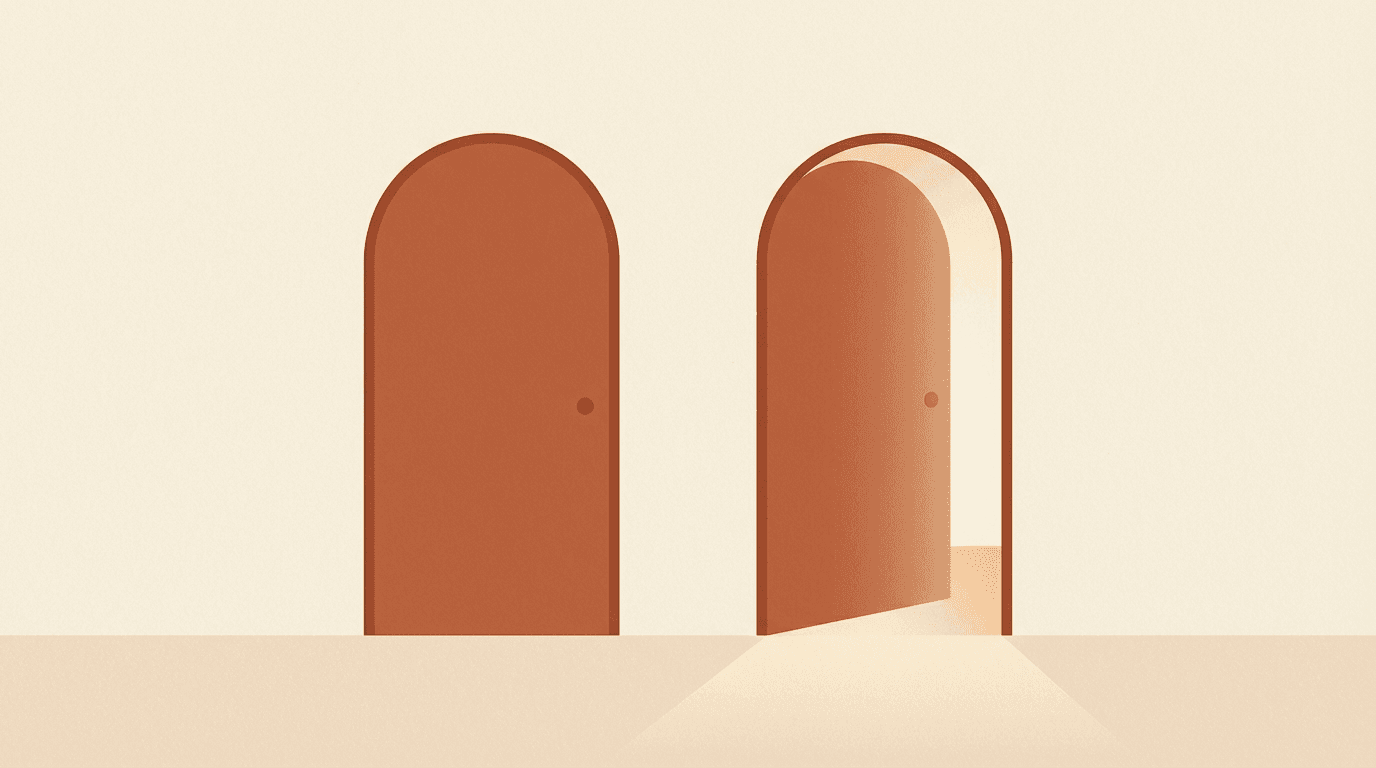
- Most decisions are reversible — treat them like doors you can walk back through, not one-way commitments.
- Set a time limit before researching — 'I'll decide by 4 p.m.' forces you to stop when new info stops changing the answer.
- Use 'good enough' instead of 'best' — maximizers feel worse about their choices than satisficers, even with objectively better outcomes.
- When torn, flip a coin to find your gut — your reaction to the result tells you what you already wanted.
Quick reset checklist
- Set a deadline for this decision (15 min, 1 hour, by 5pm)
- Write 3 criteria the option must meet
- Pick the first option that meets all 3
- Close the loop — stop revisiting today
satisfaction in satisficers vs. maximizers
Schwartz, Swarthmore
decisions outperform perfect-but-late in business
Bezos, two-way doors
outcomes from quick gut calls in complex domains
Gigerenzer, MPI
Try this first
The 10/10/10 rule
- 01
10 minutes from now
How will I feel about this then?
- 02
10 months from now
Will this still matter?
- 03
10 years from now
Will I even remember it?
- 04
Decide now
Most agonizing choices fail the 10-month test.
The fastest way to make better decisions is to make more of them faster. Based on research from Dr. Barry Schwartz at Swarthmore College, people who use simple criteria and choose the first satisfactory option — satisficers — report higher life satisfaction than those who exhaustively analyze every possibility. Decision speed is not recklessness. It is the recognition that most deliberation past a certain point does not improve the outcome — it only increases regret, anxiety, and wasted time.
If you have spent thirty minutes deciding where to eat, a week comparing two nearly identical products, or months agonizing over a career move you could reverse in six months, you do not have a decision-making problem. You have a decision-making process problem. The Brain Deck's "Can't Decide" category includes strategies specifically for this — frameworks that replace open-ended deliberation with structured, time-limited choosing.
Why Does Deciding Feel So Hard?
Three psychological forces conspire against you. Dr. Barry Schwartz's paradox of choice research identifies the first: more options create more anxiety, not more satisfaction. When you have three options, choosing feels manageable. When you have thirty, every choice requires giving up twenty-nine alternatives, and your brain mourns each one.
Dr. Roy Baumeister's research on decision fatigue identifies the second: decision-making draws from a limited energy pool. Every choice you make — from what to wear to what to eat to which email to answer first — depletes the same cognitive resource. By afternoon, the tank is low, and even simple decisions feel agonizing.
The third force is what psychologists call reversibility blindness: we treat most decisions as permanent when very few actually are. We agonize over a meal delivery service we could cancel tomorrow, or a productivity app we could switch in an hour. The perceived permanence inflates the stakes artificially.
What Is Satisficing and Why Does It Lead to Better Outcomes?
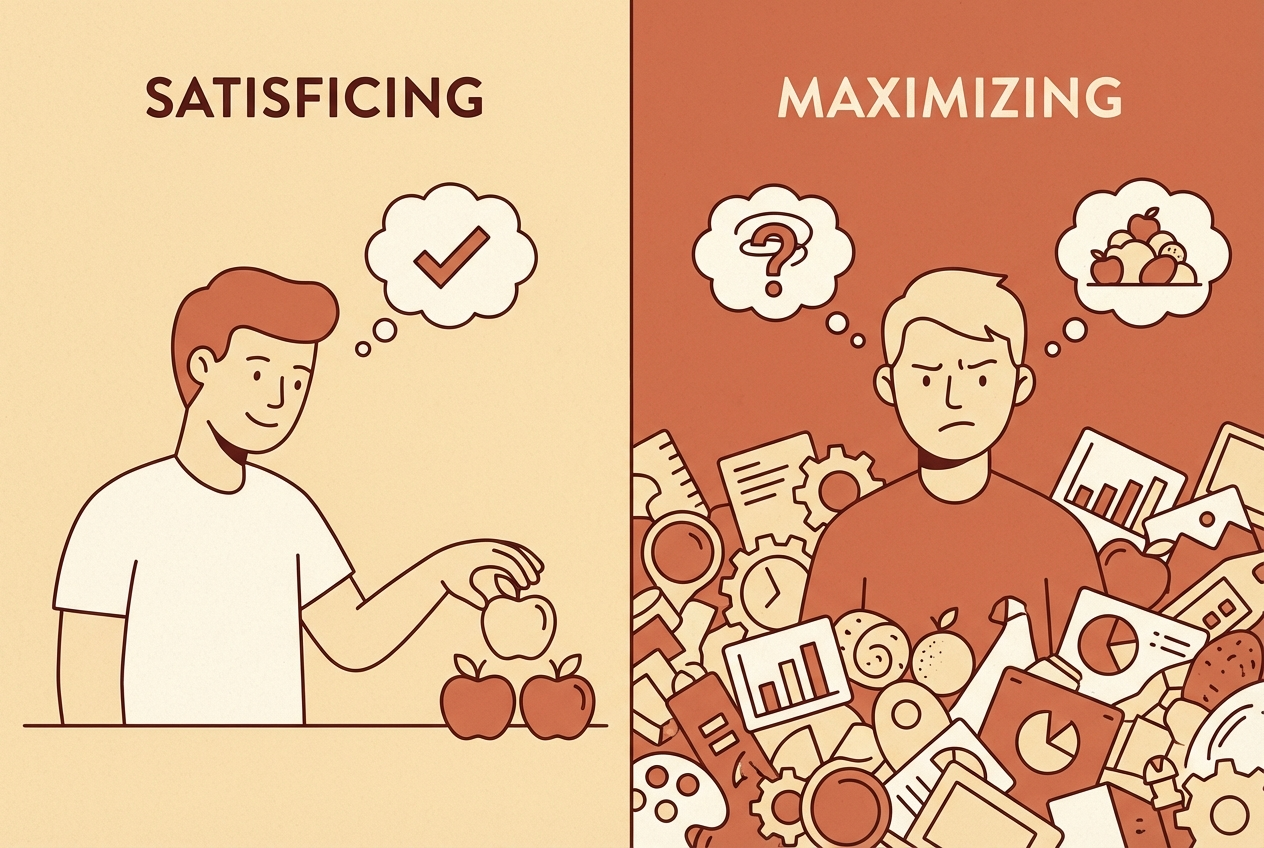
Dr. Barry Schwartz's research divides decision-makers into satisficers (people who set criteria and choose the first option that meets them) and maximizers (people who examine every option to find the absolute best). The counterintuitive finding: satisficers consistently report higher satisfaction with their decisions, even though maximizers technically choose objectively "better" options.
The satisficer who chose the first good-enough restaurant enjoys dinner. The maximizer who spent an hour researching the "best" restaurant spends dinner wondering if the other place would have been better.
The Brain Deck's "Pick One Thing" strategy applies this directly: before making any decision, define three to five criteria that actually matter. Once you find an option that meets all your criteria, choose it. Stop looking. The marginal improvement from continued searching almost never justifies the cognitive cost.
How Do You Know If a Decision Deserves Deep Deliberation?
Amazon CEO Jeff Bezos divides decisions into two types: one-way doors (irreversible or very costly to reverse) and two-way doors (easily reversible — you can walk through, look around, and walk back). His key insight: most decisions are two-way doors, but we treat them like one-way doors.
The Brain Deck includes a "Reversibility Test" concept: before giving any decision extended deliberation, ask "if this does not work out, how hard is it to change course?" If the answer is "not very," make the decision in minutes, not days. Reserve deep analysis for decisions that are genuinely irreversible — accepting a job in another country, having a child, selling a business. Everything else gets the two-way door treatment.
What Decision Frameworks Actually Speed Things Up?
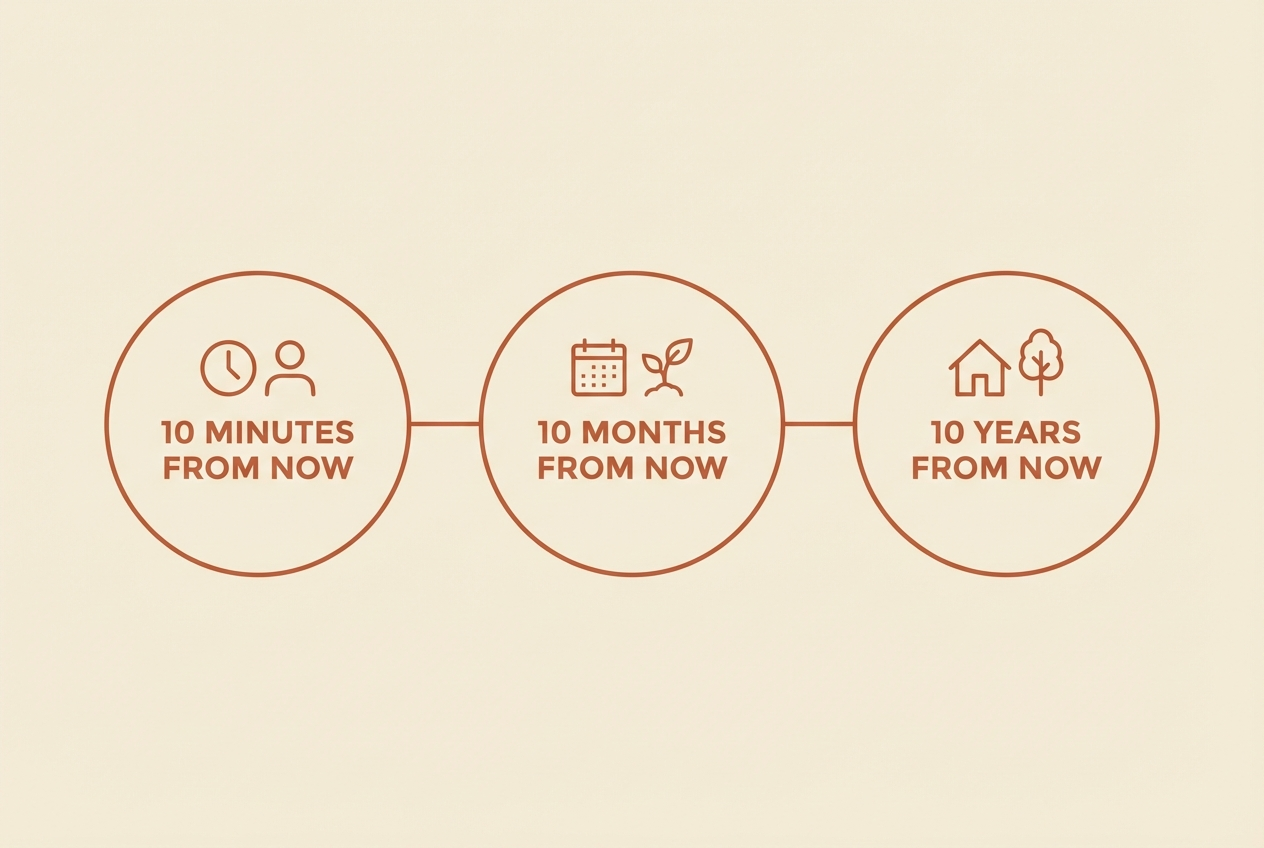
The 10/10/10 Rule: When stuck, ask three questions — how will I feel about this decision in 10 minutes? In 10 months? In 10 years? Based on research from behavioral science, this exercise forces you to zoom out from immediate anxiety and assess actual long-term impact. Most agonizing decisions are completely irrelevant at the 10-month mark. Recognizing that in advance gives you permission to decide now.
The WRAP Method: Chip and Dan Heath's framework: Widen your options (avoid binary framing), Reality-test assumptions (talk to people who have made similar choices), Attain distance (ask what you would advise a friend), Prepare to be wrong (set a tripwire for reassessment). This works well for higher-stakes decisions that need more than a gut call.
Decision Deadlines: Dr. Piers Steel's research on temporal discounting confirms that Parkinson's Law applies to decisions: deliberation expands to fill the time available. If you give yourself a week to pick a hotel, you will spend a week comparing hotels. Give yourself thirty minutes and you will pick a perfectly good hotel in thirty minutes. Set explicit deadlines: 60 seconds for trivial decisions, 24 hours for moderate ones, one week for significant ones.
Can You Trust Your Gut?
Yes — more than you think. Researcher Gerd Gigerenzer has spent decades studying intuitive decision-making and found that for decisions involving complex variables and uncertainty, quick intuitive judgments often outperform lengthy analytical ones. Your unconscious mind processes far more information simultaneously than your conscious mind can. If you have gathered reasonable information and your gut is pulling you in a direction, that signal is worth respecting.
The Brain Deck's "Action Before Motivation" strategy applies here: at a certain point, more thinking will not improve your decision. Only experience will. Make the call, observe the result, and adjust. Research by Dr. Carol Dweck at Stanford supports this — people with a growth mindset treat decisions as experiments rather than verdicts, which reduces the emotional stakes and increases decision speed.
How Do You Stop Second-Guessing After You Decide?
Post-decision rumination is one of the biggest drains on mental energy, and based on research from Dr. Barry Schwartz, it does not improve outcomes. The Brain Deck strategy "Worry Window" helps here: if you catch yourself revisiting a decision, schedule a specific time to reassess (say, one week from now) and refuse to deliberate before then. This gives your brain a guaranteed review point, which makes it easier to let go in the present.
The decision is not truly made until you stop revisiting it. Once you have chosen using any framework above, close the loop: "The decision is made. My job now is to make this decision work." Put your energy into execution, not re-evaluation. For more on managing the mental chatter that follows decisions, our guide on how to stop overthinking offers specific techniques.
What Is the Simplest Way to Start Deciding Faster?
Reduce the number of decisions you make. The fastest decision is the one you never have to make. Based on research from Dr. Roy Baumeister, automating recurring choices preserves cognitive resources for the decisions that truly matter:
- Create defaults: Eat the same breakfast on weekdays. Wear a personal uniform. Automate recurring bills.
- Use rules: "I always say yes to invitations from close friends." "I never schedule meetings before 10 AM." Rules replace decisions with policies.
- Delegate: Let someone else choose the restaurant. Not every decision needs your input.
If you find that too many choices are draining your mental energy, elimination is often more effective than any framework. The Brain Deck's "Ruthless Priorities" card captures this: decide what matters, eliminate what does not, and free your brain for the choices that actually shape your life.
| Dimension | Maximizer | Satisficer |
|---|---|---|
| Process | Examines every option | Defines criteria, picks first match |
| Time spent | Hours or days | Minutes |
| Satisfaction | Lower, more regret | Higher, less rumination |
| Best for | Truly irreversible choices | Most daily decisions |
Common mistake
What people on Reddit actually say
- r/productivity⬆ strong consensus
r/productivity regulars argue that most decisions aren't worth more than 10 minutes. Tie-breakers (coin flip, second in line, default option) are almost always as good as exhaustive deliberation.
- r/decidingtobebetter💬 commonly repeated
r/decidingtobebetter consensus: indecision is a decision — usually the worst one. Picking and committing to an okay option beats waiting for a perfect one that never arrives.
- r/entrepreneur🔥 loud consensus
r/entrepreneur threads stress that speed of decisions compounds. Founders who decide quickly and course-correct outperform those who deliberate perfectly and act late.
Paraphrased consensus from public threads — no direct user quotes.
Pull a card · free sample
Stuck choosing? Pull from the 'Can't Decide' suit — the card removes the choice for you in 30 seconds.
Pull a random card →
Tools that help with this
Ready to get unstuck?
The Brain Deck gives you 52 science-backed strategies in your pocket — a physical card deck you keep on your desk, no app required.
See the CardsLaunching soon · 54 cards · Premium matte finish