How to Stop Overthinking: 6 Ways to Break the Loop
Overthinking isn't deep thinking — it's a loop. Research shows rumination masquerades as problem-solving while draining your energy and stalling decisions. Here's how to break free.
By The Brain Deck Editorial
Overthinking masquerades as analysis; it's actually emotional avoidance — set a hard time limit on thinking, then take one small imperfect action.
Key Takeaways
- Overthinking masquerades as problem-solving — it feels productive but rarely produces new information or decisions.
- Set a hard time limit on thinking — 15 minutes of structured reflection, then act or drop it for today.
- Move your body to change your mind — a walk or any physical state shift breaks rumination faster than more thinking.
- Write the worry down to contain it — on paper, most spirals look smaller and more answerable than they felt in your head.
Try this in the next 60 seconds
- Set a 15-minute timer for thinking, then stop
- Write the 3 options you're spinning on
- Pick the one that feels 70% right
- Commit to it for 24 hours, then reassess

less likely to buy when shown 24 vs. 6 options
Iyengar & Lepper
satisfaction in maximizers vs. satisficers
Schwartz, Swarthmore
minutes of looping = rumination, not problem-solving
Pychyl, Carleton
Try this first
The 4-step rumination break
- 01
Cap the thinking time
15 minutes max, then it's a decision call.
- 02
Externalize the loop
Brain-dump every option onto paper.
- 03
Move the body
Walk or stretch — physical state shifts mental state.
- 04
Take one small action
Send the rough draft. Make the call. Move.
Overthinking is not productive thinking on overdrive — it is a repetitive emotional loop that disguises itself as analysis. Based on research from Dr. Timothy Pychyl at Carleton University, rumination is a form of emotional avoidance: your brain replays scenarios not to solve them but to postpone the discomfort of deciding or acting. The fastest way to stop overthinking is to impose a decision deadline, externalize your thoughts through writing, and take one small imperfect action — because action, not more thinking, is what breaks the loop.
If you have ever spent an hour mentally rehearsing a conversation that takes three minutes in real life, you already know the cost. Overthinking steals time, erodes confidence, and leads to worse decisions. The strategies below are drawn from cognitive behavioral research and the "Can't Decide" category of The Brain Deck.
Why Does Overthinking Feel Productive?
Rumination tricks you because it feels like effort. You are thinking hard, weighing options, considering angles. But research by Dr. Barry Schwartz at Swarthmore College reveals the paradox: the more options you analyze, the less satisfied you become with any choice. His work on the paradox of choice shows that exhaustive analysis does not lead to better outcomes — it leads to paralysis and regret.
Here is a quick test from clinical psychology: if you have been thinking about the same issue for more than ten minutes without generating a new insight or action step, you are ruminating, not problem-solving. Problem-solving moves linearly toward a decision. Rumination circles. Recognizing which mode you are in is the first intervention.
What Is the Real Cost of Rumination?
Dr. Roy Baumeister's research on ego depletion demonstrates that mental deliberation consumes the same finite cognitive resources as actual work. Every minute you spend overthinking a decision is a minute of decision-making energy you will not have later. This is why overthinkers often feel exhausted at the end of a day in which they accomplished nothing — the mental cycling burned through their reserves.
The costs compound. Overthinking a work decision delays the work itself, which creates deadline pressure, which triggers more anxiety, which fuels more overthinking. If you notice this pattern regularly draining your capacity, our guide on decision fatigue explains the neuroscience behind why your brain runs out of gas.
How Do You Interrupt the Overthinking Loop?
The Brain Deck includes several strategies designed for exactly this moment. The most immediately useful ones:
- Worry Window: Schedule a specific 15-minute block — say, 5 PM — as your designated worry time. When anxious thoughts surface outside that window, acknowledge them and postpone: "I will think about that at five." Based on research from clinical anxiety treatment, this technique trains your brain that worries will get attention — just not unlimited, on-demand attention. By the time your window arrives, most concerns have already faded.
- Brain Dump: Grab a pen and spend five minutes externalizing every thought circling in your head. Do not organize. Do not evaluate. Just dump. The brain dump technique works because your working memory holds roughly four items — when you try to juggle thirty, your brain keeps recycling them to avoid losing track. Writing them down tells your system it is safe to let go.
- Pick One Thing: Look at everything you have been deliberating about and choose one item. Not the best item. Any item. Research by Dr. Barry Schwartz confirms that satisficing — choosing the first option that meets your criteria — produces higher satisfaction than maximizing. For more on this, see our guide on how to make decisions faster.
Can You Think Your Way Out of a Thinking Problem?
No. And this is the core insight. Dr. Piers Steel's procrastination equation shows that as the perceived complexity of a task increases, the likelihood of action decreases — and overthinking is the mechanism that inflates perceived complexity. The more you analyze, the bigger and scarier the task appears.
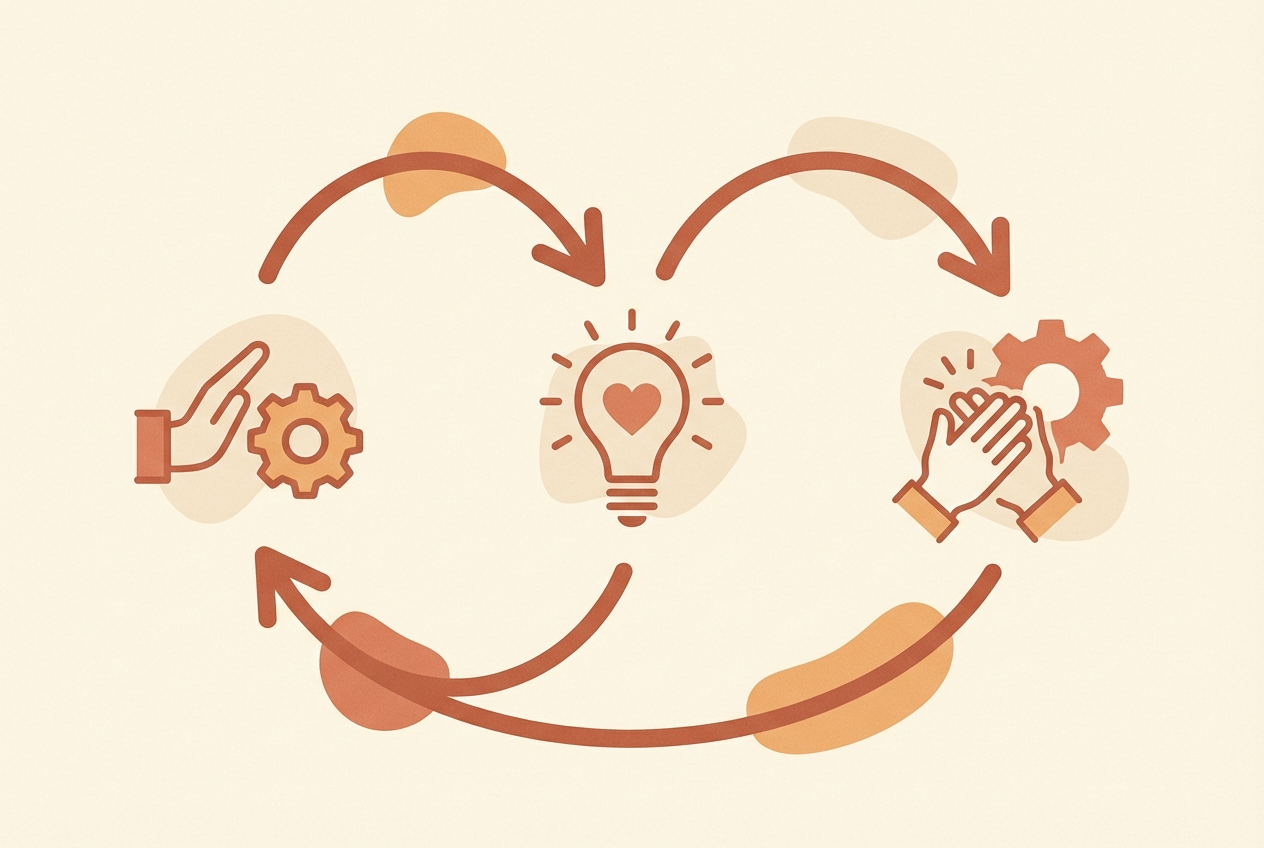
The Brain Deck strategy "Action Before Motivation" addresses this directly. You do not wait until you have figured everything out. You take one small imperfect step — send the rough draft, make the phone call without a script, start the project with an incomplete plan — and let real-world feedback replace hypothetical speculation. Research by Dr. Teresa Amabile at Harvard Business School confirms that even small progress generates positive emotion, which generates clarity, which generates more progress. Thinking harder does not do this. Moving does.
What If the Overthinking Is About a Specific Decision?
When rumination clusters around a particular choice, structured frameworks outperform unstructured deliberation every time. Try these:
- The 10/10/10 Rule: Ask yourself how you will feel about this decision in 10 minutes, 10 months, and 10 years. Most agonizing decisions are irrelevant by the 10-month mark, which gives you permission to decide now.
- Two-Way Door Test: Ask whether the decision is reversible. If you can change course later, stop deliberating and walk through the door. Most decisions are far more reversible than your overthinking brain wants to believe.
- Thought Defusion: Take your looping thought and rephrase it: "I am having the thought that I will fail" instead of "I will fail." This technique from Acceptance and Commitment Therapy creates psychological distance between you and the thought, reducing its emotional charge.
If decisions are a recurring source of overthinking, our full guide on making decisions faster walks through these frameworks in depth.
How Do You Build Long-Term Resistance to Overthinking?
Dr. Fuschia Sirois at Durham University has found that self-compassion is one of the strongest predictors of reduced rumination. Overthinkers tend to be harsh self-critics, and that criticism generates exactly the negative emotion that keeps the loop spinning. Replacing "I should have figured this out by now" with "This is a hard decision and I am doing my best" is not soft — it is strategic. It removes fuel from the rumination engine.
Daily mindfulness practice — even five minutes — also builds what researchers call attentional control: the ability to notice a thought without engaging with it. You observe the worry, let it pass, and return to the present. Each repetition strengthens the neural circuits responsible for disengaging from rumination. Based on research from Stanford, even brief regular practice produces measurable changes within two to four weeks.
What Should You Do Right Now?
If you are overthinking something at this moment, here is your next sixty seconds: grab a piece of paper, write down the three options you are considering, circle the one that feels 70% right, and commit to it for 24 hours. You are not choosing forever. You are choosing for today. Tomorrow you can reassess with actual experience instead of hypothetical worry.
Overthinking is a deeply ingrained habit, but habits respond to consistent intervention. The Brain Deck's "Can't Decide" cards — Worry Window, Pick One Thing, Do It Badly, Action Before Motivation — are designed to interrupt the loop at any point. Use one. Use it imperfectly. And notice what happens when you trade ten more minutes of thinking for ten seconds of doing. The clarity you were searching for was never in the next thought. It was in the next action.
Common mistake
What people on Reddit actually say
- r/overcomingprocrastination⬆ strong consensus
r/overcomingprocrastination regulars describe overthinking as a form of avoidance — thinking feels like progress but protects you from the risk of actually deciding. Naming that dynamic often breaks the loop.
- r/adhdwomen🔥 loud consensus
r/adhdwomen threads frequently frame rumination as a nervous-system state, not a thinking problem. Tools that regulate the body — cold water, long exhales, walking — tend to outperform 'just stop thinking' advice.
- r/ZenHabits💬 commonly repeated
r/ZenHabits consensus: overthinking shrinks when you ask 'what's the next physical action?' and then take it. The thinking resumes in a more useful form after the action, not before.
Paraphrased consensus from public threads — no direct user quotes.
Pull a card · free sample
Spinning in your head? Pull a card from the 'Can't Decide' suit for one concrete move that interrupts the loop.
Pull a random card →
Tools that help with this

Ready to get unstuck?
The Brain Deck gives you 52 science-backed strategies in your pocket — a physical card deck you keep on your desk, no app required.
See the CardsLaunching soon · 54 cards · Premium matte finish