Why Petting a Dog Resets Your Stressed Brain
Ten minutes with a dog measurably lowers cortisol - and the mechanism explains why it works when deep breaths and willpower don't. The science of the fastest stress reset most people are ignoring.
By Hilly Shore Labs
Key Takeaways
- Ten minutes of petting measurably lowers cortisol - a randomized trial found hands-on interaction with dogs and cats dropped the stress hormone; watching from a distance did not.
- It's a body-first reset - touch, warmth, and a calm animal signal safety directly to the nervous system, bypassing the racing thoughts that thought-based calming has to argue with.
- The effect is mutual - positive interaction raises oxytocin in both human and dog, so you are genuinely co-regulating each other.
- Use it on purpose - go to the dog first after a stressful event, give it real attention, and stack it with a walk for movement + daylight + animal in one reset.
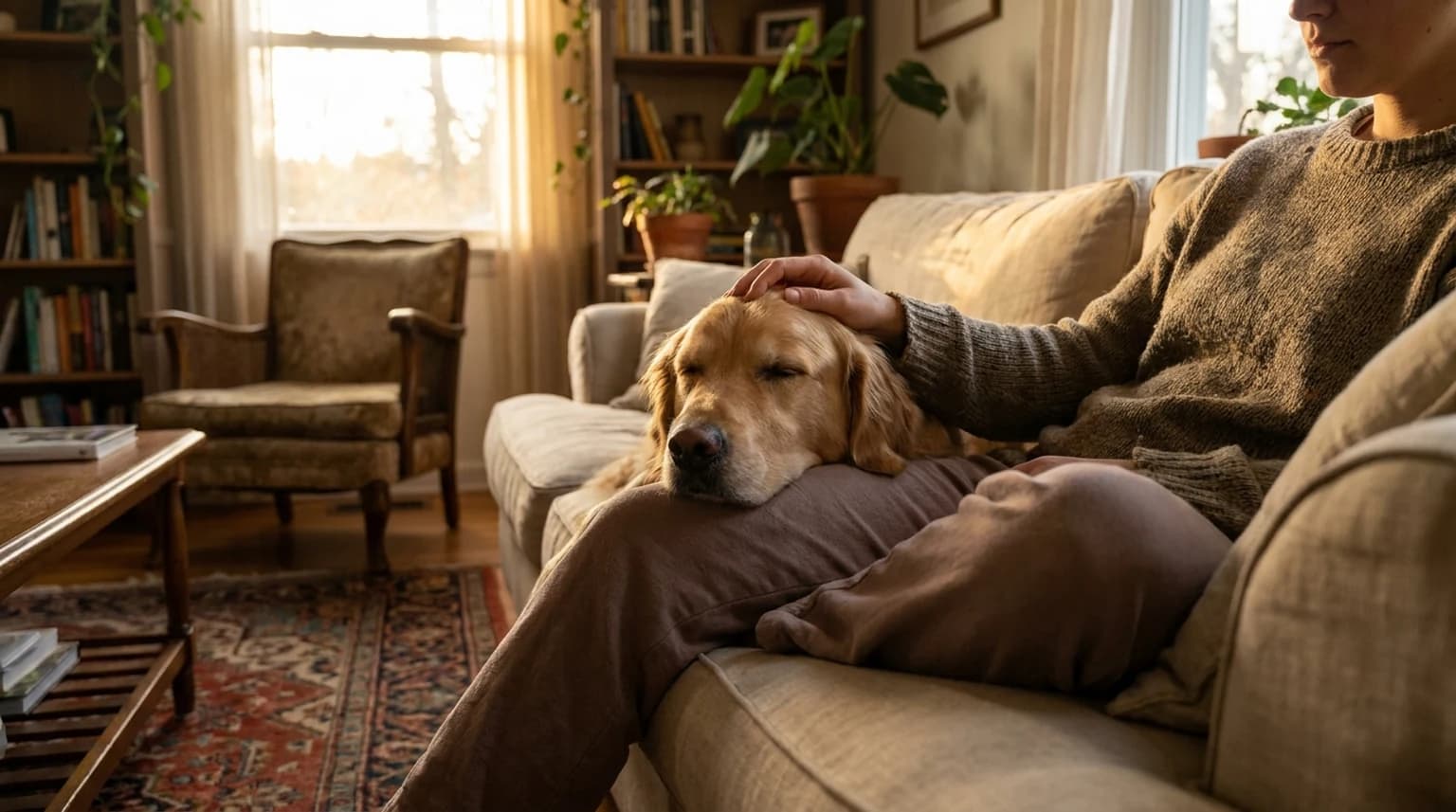
You know the moment: you close the laptop after a brutal call, the dog wanders over, and two minutes of absent-minded ear-scratching later the knot in your chest has somehow loosened. That is not sentimentality. It is one of the better-documented stress interventions available, and it works through channels that willpower cannot reach.
Short answer: physical interaction with a dog reliably lowers cortisol, the body's main stress hormone, with effects measurable after as little as ten minutes. It works because touch, warmth, and slow social connection engage the body's calm-down system directly - the same system that racing thoughts keep switching off. You cannot think your way out of a stress spiral, but you can often pet your way out of one.
The evidence is better than you'd expect
This is not a wellness-blog claim. A randomized study of stressed university students found that just 10 minutes of petting cats and dogs produced a measurable drop in salivary cortisol (Pendry & Vandagriff, 2019, AERA Open) - and notably, watching the animals from a distance did not produce the same effect. The touch was the active ingredient, not the cuteness.
The interaction runs both ways, which is part of why it feels so complete. Research on owners and their dogs found that positive interaction raised oxytocin in both species (Odendaal & Meintjes, 2003, The Veterinary Journal) - the same bonding hormone that underpins human closeness. Your dog is not just a stress object; it is a genuine social partner whose biology is synchronizing with yours.
Why it works when thinking doesn't
When you are stressed, the sympathetic nervous system - fight or flight - is running the show. Trying to reason yourself calm asks the most stressed part of your brain to fix itself. Petting a dog sidesteps the argument entirely:
- Slow rhythmic touch activates pressure receptors that signal safety directly to the nervous system.
- Warmth and contact are primal safety cues - older and deeper than language.
- The dog's own calm is contagious. A relaxed animal breathing slowly next to you is a pacing signal your body reads automatically.
- It pulls attention outward. Rumination needs an inward focus to survive; a warm, present animal is an attentional exit ramp.
Using it deliberately
Most dog owners already get accidental doses of this. The upgrade is using it on purpose:
- Make it the post-stress ritual. After a hard call or a doomscroll spiral, go find the dog first - before the next task. Two minutes of real attention on the animal beats twenty minutes of frazzled pushing-through.
- Actually attend to it. The studies involve genuine interaction, not petting with one hand while scrolling with the other. The attention shift is part of the mechanism.
- Use the walk as a double reset. Movement plus animal plus daylight stacks three regulators in one - the reason the dog walk is such an outsized mood intervention.
- A calm dog helps more. The reset works best when the dog itself is settled. If your dog is anxious or wired, that is its own solvable problem - PawBench's calming and anxiety guide covers what actually helps, and a puzzle toy that gives the dog its own decompression outlet tends to make it a better co-regulator for you.
What this does not claim
A dog is not a treatment for an anxiety disorder, and this is not an argument to get one for stress relief alone - a dog is a large commitment that adds its own stressors. The narrow, well-supported claim: if a dog is already in your life, deliberate physical interaction with it is one of the fastest, most reliable nervous-system resets you have, and most people underuse it.
Dogs and stress FAQ
How long does petting a dog take to lower stress?
Measurable cortisol reduction showed up after just 10 minutes of hands-on interaction in controlled research. Subjectively, most people feel the shift within a couple of minutes.
Does it work with cats too?
Yes - the Pendry & Vandagriff study used both cats and dogs, and the cortisol effect held. The active ingredient is calm physical interaction with a friendly animal.
Does watching dog videos do the same thing?
Not the same. In the research, watching animals without touching them did not produce the same cortisol drop. Touch appears to be the key channel - the videos are pleasant, but they are not the intervention.
Why does my dog seem calmer after we cuddle too?
Because the effect is mutual - positive interaction raises oxytocin in both human and dog. You are co-regulating each other, which is why a settled dog and a settled owner tend to come as a pair.
Sources
- Pendry, P., & Vandagriff, J. L. (2019). Animal Visitation Program (AVP) reduces cortisol levels of university students: a randomized controlled trial. AERA Open - 10 minutes of hands-on petting lowered salivary cortisol; observation alone did not.
- Odendaal, J. S. J., & Meintjes, R. A. (2003). Neurophysiological correlates of affiliative behaviour between humans and dogs. The Veterinary Journal - positive interaction raised oxytocin in both species.
What people on Reddit actually say
- r/dogs⬆ strong consensus
A recurring theme from remote workers is that the dog functions as a stress barometer and reset button in one - people describe stepping away to sit with the dog after hard meetings as the habit that keeps the workday humane.
- r/Anxiety💬 commonly repeated
Many report that petting their animal is the only grounding technique that works mid-spiral, precisely because it requires no mental effort - the common phrasing is that the dog does the regulating for you.
Paraphrased consensus from public threads — no direct user quotes.
Ready to get unstuck?
The Brain Deck gives you 52 science-backed strategies in your pocket — a physical card deck you keep on your desk, no app required.
See the CardsLaunching soon · 54 cards · Premium matte finish