Sleep Debt and Attention: Why You Can't Feel the Cost
Six hours can feel normal while attention keeps deteriorating. The sleep-restriction research explains why self-assessment is the first thing not to trust.
By Hilly Shore Labs
Key Takeaways
- Feeling normal is not performance data - subjective sleepiness flattened while measured attention lapses continued rising.
- Six hours accumulated a real cost - across 14 nights, the six-hour group deteriorated toward acute-deprivation performance levels.
- Focus systems sit downstream of sleep - they can reduce load, but they cannot restore vigilance removed by repeated short sleep.
- After one bad night, manage risk - shorten blocks, externalize steps, review outputs, and delay irreversible decisions when possible.
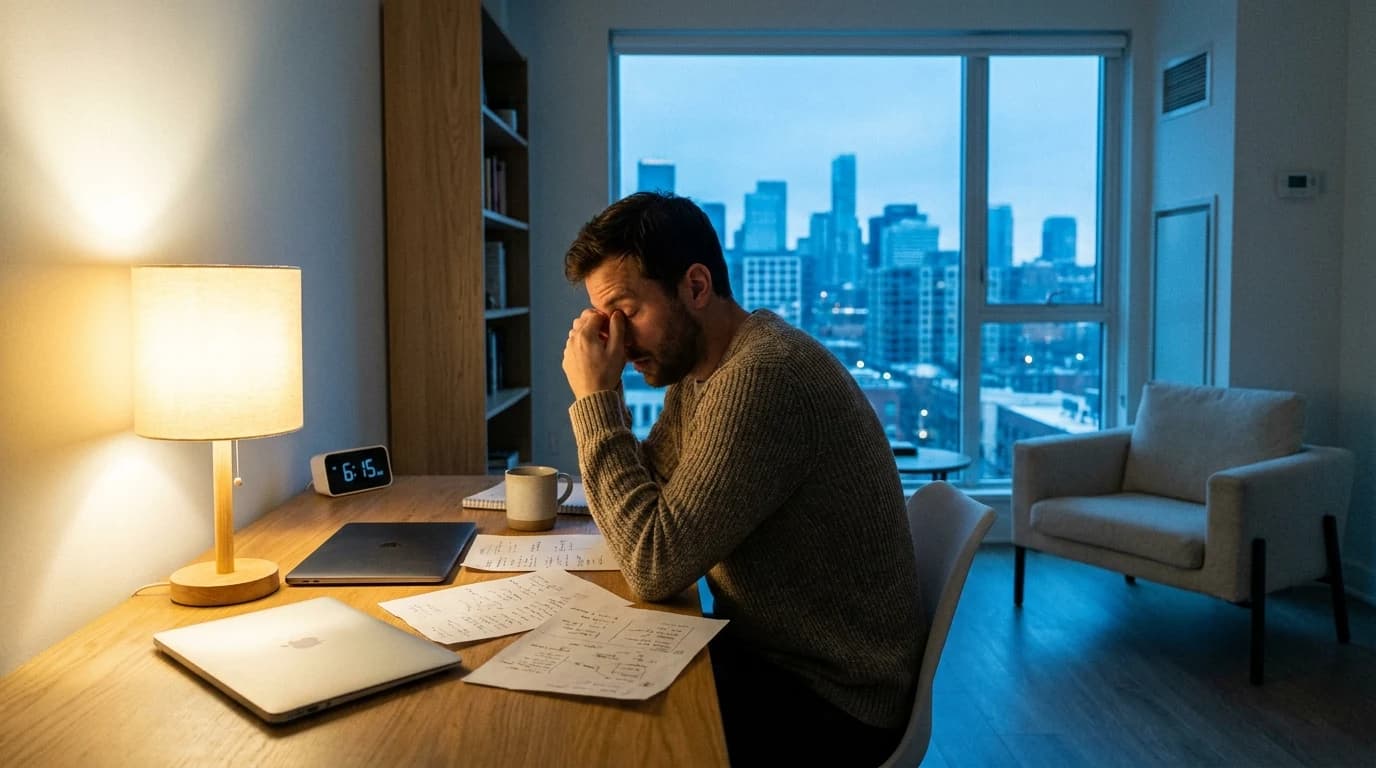
Short answer: sleep debt does not merely make you feel tired. It makes sustained attention less reliable while your sense of tiredness partially adapts. That mismatch is the trap. In controlled research, people limited to six hours in bed for two weeks kept accumulating attention lapses even as their subjective sleepiness changed much more slowly. Feeling normal was not evidence of performing normally.
This matters because almost every focus technique assumes the attention system is available to use. Time blocking, music, a cleaner desk, and a good task list can reduce friction. None can restore vigilance that repeated short sleep has removed.
The experiment behind the warning
In the 2003 Van Dongen et al. study in Sleep, healthy adults were assigned four, six, or eight hours in bed for 14 consecutive nights. A separate group stayed awake for up to three nights, giving the researchers an acute-deprivation comparison. Attention and working-memory tests were repeated throughout each day.
The eight-hour group stayed broadly stable. The four- and six-hour groups did not: their deficits accumulated across days. By the end, the six-hour condition had reached attention impairment in the range produced by roughly two nights without sleep. This was not one groggy morning after a late flight. It was the ordinary pattern many people call a workweek.
- 14nights of restricted sleepVan Dongen et al., 2003
- 6 htime in bed in the deceptively normal groupnot necessarily six hours asleep
- 9×daily attention checksevery two hours
The part people miss: your feelings flatten first
A later open-access review of the controlled sleep-restriction data shows the split clearly. Psychomotor-vigilance lapses increased close to linearly across the 14 days, while ratings of sleepiness and fatigue rose much less after the first days. At the worst performance point, the four- and six-hour groups described themselves as only slightly sleepy.
That does not mean their bodies adapted. It means their self-report adapted. The sentence “I am fine on six hours” is therefore not a reliable measurement; it is close to what the study predicts someone with accumulated impairment may sincerely report.
| Signal | What happens across short nights | Can you trust it? |
|---|---|---|
| How sleepy you feel | Rises, then changes more slowly | Weak as a solo check |
| Attention lapses | Continue accumulating | Better measured by errors and drift |
| Working-memory throughput | Deteriorates with restriction | Watch re-reading and lost steps |
| Caffeine alertness | May mask the feeling temporarily | Not proof the debt is repaid |
What one bad night actually costs
One short night is not the same as two weeks of restriction, and the study should not be stretched into a universal conversion table. The practical cost is variability: more moments when attention briefly fails, reaction slows, or a step falls out of working memory. You may still do excellent work, but you are asking a less stable system to deliver it.
After a single bad night, move the work instead of pretending the capacity is unchanged:
- Protect the highest-risk decisions. Delay irreversible choices, long drives when drowsy, and precision work if you can.
- Externalize the sequence. Use a written checklist for tasks with multiple steps. Do not make working memory hold the plan.
- Shorten the focus block. Use visible checkpoints and review before sending. Attention lapses are intermittent, so inspection matters.
- Keep caffeine in its lane. It can change alertness, but it does not turn a short night into recovered sleep. Our caffeine and focus guide covers the timing trade-off.
- Make the next night boring. The recovery move is an adequate sleep opportunity, not squeezing more output from the same depleted system.
Use behavior as the dashboard
Because subjective sleepiness is a weak gauge, watch for observable drift: reading the same paragraph repeatedly, missing exits, losing the next step, sending small-error messages, or needing constant novelty to stay engaged. These are not a home diagnosis, but they are better prompts to reduce risk than “I do not feel that tired.”
If focus trouble persists despite adequate sleep opportunity, or sleepiness affects driving and daily safety, this moves beyond productivity advice and belongs with a healthcare professional. The point is not to blame every difficult day on sleep. It is to stop treating a pleasant feeling of adaptation as proof.
Sleep debt and attention FAQ
Can your body adapt to six hours of sleep?
Your feeling of sleepiness can partially adapt, but controlled research found attention and working-memory performance continued to deteriorate across 14 nights of six-hour sleep opportunities. Feeling adapted and performing normally are different claims.
Can you repay sleep debt in one night?
One longer sleep opportunity may help, but this experiment was not evidence for a simple hour-for-hour repayment formula. Treat recovery as restoring adequate sleep opportunity consistently, not as a one-night transaction.
Should I use a focus technique after a bad night?
Yes, but use it to reduce load: shorter blocks, fewer switches, checklists, and review points. Do not use a technique to justify safety-sensitive or irreversible work when attention is visibly unstable.
Sources
Ready to get unstuck?
The Brain Deck gives you 52 science-backed strategies in your pocket — a physical card deck you keep on your desk, no app required.
See the CardsLaunching soon · 54 cards · Premium matte finish