Can You Build a 'Second Brain' on Paper? The Analog Case
The digital 'second brain' is real and useful — but a notebook beats an app at the one job that matters most when you're stuck: getting a task out of your head and into your hands right now. An honest look at where each one actually wins.
By Hilly Shore Labs
Digital second brains win at storage, search, and synthesis. Paper wins the capture moment — when your head is full and you need to start. Use both: capture rough on paper, archive the keepers in software.
Key Takeaways
- Working memory holds only ~3–5 items — the whole point of any second brain is to offload the rest, on paper or in software.
- Digital wins the archive — search, volume, linking, and synthesis are jobs a notebook can't do.
- Paper wins the capture moment — handwriting engages the brain more, single-purpose beats distracting, and a blank page holds zero decisions.
- A bigger system doesn't make you think better — an externalized one does. More notes than you re-read is a graveyard, not a brain.
- The pragmatic setup is both — capture rough on paper, file the keepers digitally.
Try this in the next 60 seconds
- Grab any sheet of paper or a card
- Brain-dump every open loop in your head, unsorted
- Circle the one next action you'll do now
- File anything worth keeping into your app later — not now
items working memory can hold at once
Cowan, PMC2864034
WM capacity AND duration, per cognitive load theory
PMC6435105
brain connectivity from handwriting vs typing
Frontiers, 2024
Try this first
The "second brain" idea — popularized by Tiago Forte and his CODE method (Capture, Organize, Distill, Express) — is one of the best productivity frameworks of the last decade. The premise is solid: your mind is for having ideas, not holding them, so you offload storage to a trusted external system and free your head to think. That's genuinely true, and a well-run digital system delivers it at a scale paper never will.
But "second brain" has quietly become synonymous with a specific stack: Notion, Obsidian, tags, backlinks, a graph view. And a lot of people who set one of those up still feel exactly as stuck as before. So the honest question isn't "digital or analog" — it's which job are you actually trying to do? For long-term knowledge management, digital wins, and it isn't close. For the in-the-moment job of unloading your working memory and reducing decision load so you can start, paper has real, research-backed advantages. This is the case for analog — made without pretending the digital tools don't work.
What a Second Brain Is Actually For
Strip away the apps and the concept rests on one piece of cognitive science: your working memory is tiny. Nelson Cowan's review of the evidence puts the limit at roughly three to five meaningful items at once in young adults — not the famous "seven," and far fewer than the dozens of open loops a normal workday throws at you. Cognitive load theory builds on the same fact: working memory is, in the words of one review, "severely limited in both capacity and duration," and overloading it degrades performance.
So the core function of any second brain — digital or paper — is the same: get the open loops out of the 3-to-5-slot bottleneck and into something that holds them reliably, so the slots are free for the work in front of you. Everything else (search, linking, synthesis) is value on top of that foundation. The mistake is assuming you need the elaborate version to get the benefit. You don't. You need the offload.
Where Digital Genuinely Wins
Let's be fair to the apps, because they're better than paper at most of the lifecycle:
- Search and retrieval. Finding a note from eight months ago is instant in Obsidian and impossible in a notebook you've already filed away. For a knowledge base you'll mine for years, this alone justifies digital.
- Volume and durability. Thousands of notes, synced across devices, backed up, never lost to a coffee spill. Paper does not scale and does not back itself up.
- Linking and synthesis. Forte's "Distill" and "Express" steps — connecting ideas into something new — are dramatically easier when notes are searchable, taggable, and linkable. This is the part a notebook can't touch.
- Reference material. Articles, clippings, PDFs, code snippets — capture-once-find-forever is the whole point, and it's a digital job.
If your goal is a durable, growing knowledge library you'll draw on for years, build it digitally. The analog case is not "throw out Notion." It's narrower and more interesting than that.
Where Paper Quietly Wins: The Capture Moment
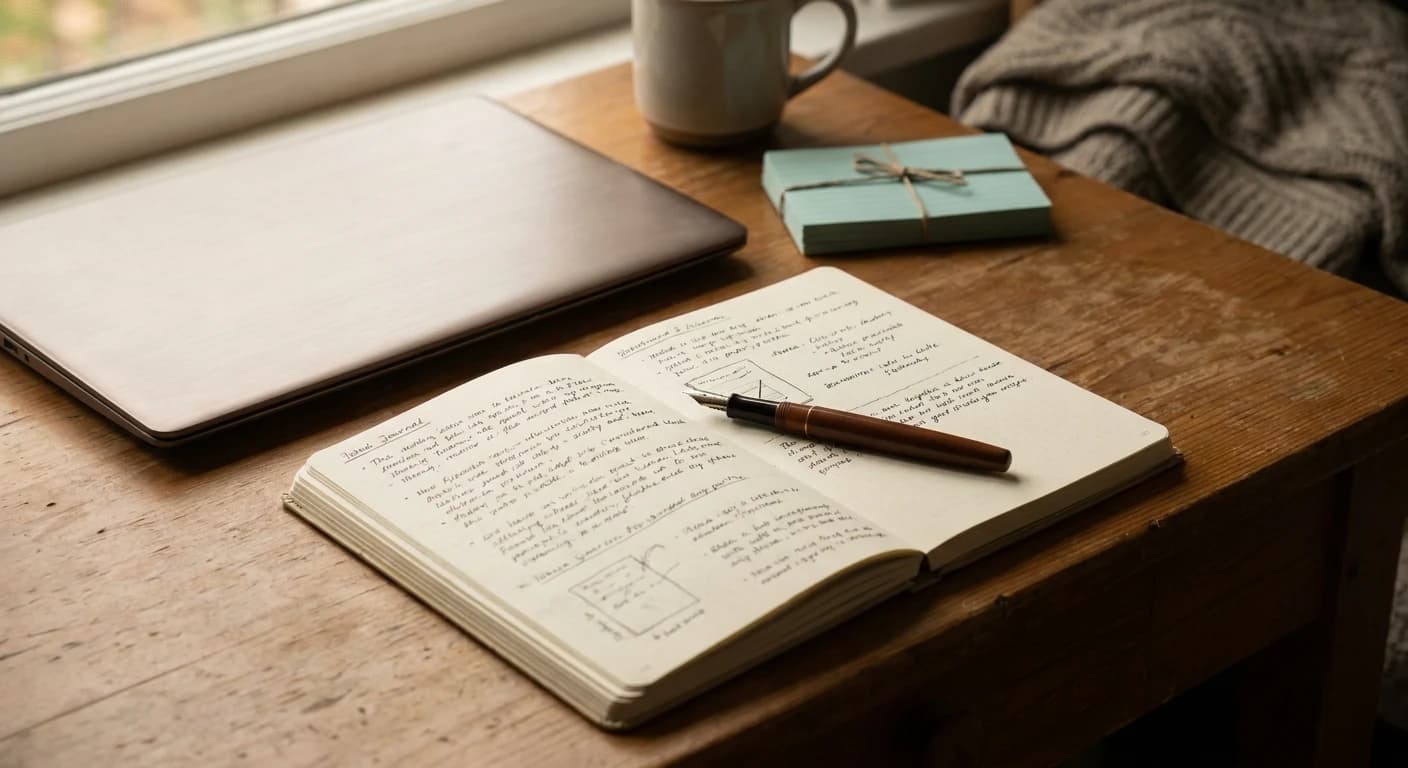
Here's the part the second-brain discourse underrates. The hardest, highest-leverage moment in the whole system isn't organizing or distilling — it's the raw capture when your head is full and you're frozen. And at that exact moment, paper has three advantages.
One: the act of writing engages your brain more deeply. A 2024 high-density EEG study from the Norwegian University of Science and Technology found that "when writing by hand, brain connectivity patterns were far more elaborate than when typewriting on a keyboard" — widespread theta/alpha coherence the authors describe as beneficial for learning and memory. The slow, deliberate hand movements of forming letters recruit more of your brain than tapping keys. For thinking-on-the-page, that's a feature.
Two: friction is the feature, not the bug. An app's frictionlessness cuts both ways — it's also frictionless to open a second tab, see a notification, and never come back. A paper notebook has exactly one function. There is nothing to click away to. When the goal is to narrow attention rather than expand it, the dumb single-purpose object beats the smart distracting one.
Three: a notebook holds no decisions. Open a digital second brain to capture one task and you face a cascade of micro-choices — which note, which tag, which folder, which template. Each one spends a slice of your already-limited working memory. Decision load is real cost. A sheet of paper asks you for nothing: you just write the next thing down. That's the difference between a tool that helps you start and a tool that quietly asks you to do setup before you can start.
Analog vs Digital: An Honest Scorecard
Neither is the winner in the abstract. They win at different jobs — the table below sums up where each one earns its place.
The Thing Most People Get Wrong
The common failure mode is treating "build a second brain" as a tooling project. You spend a weekend setting up Notion templates, watch the YouTube tutorials, build the perfect graph — and the system itself becomes a new form of productive procrastination. The research does not say a more elaborate system makes you think better. It says an externalized one does. Cowan's capacity limit doesn't care whether your offload target cost nothing or runs on a paid plan; it cares only that the loops left your head.
So the falsifiable claim is this: if your digital second brain has more notes than you've ever re-read, it isn't functioning as a second brain — it's functioning as a graveyard, and you've paid for the elaborate version of a problem a $4 notebook would have solved. The test of a second brain is not how much it stores. It's whether your actual brain feels clearer after you use it.
The Pragmatic Setup: Use Both
The honest answer most heavy practitioners land on is a split:
- Paper for capture and the daily working layer. A notebook or a few cards for the brain dump, today's three priorities, and the in-the-moment "what's the next action" — the low-decision, high-friction-resistance job where analog shines.
- Digital for the archive and synthesis layer. Anything you'll search later, link, or build on goes into the app. Capture rough on paper, file the keepers digitally — the analog equivalent of Forte's Capture, with Organize and Distill happening in the tool that's actually good at them.
This is exactly the philosophy The Brain Deck is built on. The deck isn't a knowledge base or a competitor to Notion — it's the in-the-moment analog layer. When you're stuck, you pull a physical card matched to your feeling-state and get one concrete next action, with no app to open, no tab to lose, and no setup to do first. The "Brain Dump" card is the paper second brain's core move: empty every task, worry, and fragment from your head onto paper so your working-memory slots are free. (For the digital-first version of the same idea, see our guide on how to build a second brain, and on the underlying technique, the brain dump technique.)
Can you build a second brain on paper? For the whole lifecycle — capture, organize, distill, express — no, and you shouldn't try. But for the single most important and most-skipped job, the one that decides whether you start or stay frozen, paper isn't a downgrade. It's the better tool. Build the archive in software. Do the unloading with a pen.
Sources
- Cowan, N. — "The Magical Mystery Four: How is Working Memory Capacity Limited, and Why?" (working memory limited to ~3–5 items)
- Cognitive load theory review — working memory "severely limited in both capacity and duration"
- Van der Weel & Van der Meer, Frontiers in Psychology (2024) — handwriting produces more elaborate brain connectivity than typing
- Tiago Forte — Building a Second Brain (the CODE method)
| The job | Paper / analog | Digital app |
|---|---|---|
| Capture when stuck | Zero friction, zero decisions | Cascade of folder/tag choices |
| Search & retrieval | Effectively impossible once filed | Instant, across years of notes |
| Volume & backup | Doesn't scale, no backup | Thousands of notes, synced, safe |
| Linking & synthesis | Manual and limited | Tags, backlinks, graph view |
| Distraction risk | Single-purpose, nothing to click away to | One tab away from the rest of the internet |
| Brain engagement | Handwriting = richer connectivity | Typing = faster but shallower |
Common trap
What people on Reddit actually say
- r/ObsidianMD🔥 loud consensus
r/ObsidianMD regulars repeatedly warn that building the system becomes procrastination — people spend more time tweaking templates and plugins than actually thinking. The recurring advice is to capture first and let structure emerge, not the reverse.
- r/Notion⚡ divisive
r/Notion threads are split: power users love the synthesis and search, while many admit their elaborate setups became digital junk drawers they never revisit. The durable consensus is that the value is in retrieval, not in capture.
- r/productivity⬆ strong consensus
r/productivity consensus is that a paper notebook or index cards still beat any app for the daily 'what's my next action' layer — low friction, no notifications, and nothing to set up before you can write the thing down.
Paraphrased consensus from public threads — no direct user quotes.
Pull a card · free sample
Head too full to start? Pull from the 'Overwhelmed' suit — the Brain Dump card is the paper second brain's first move.
Pull a random card →
Ready to get unstuck?
The Brain Deck gives you 52 science-backed strategies in your pocket — a physical card deck you keep on your desk, no app required.
See the CardsLaunching soon · 54 cards · Premium matte finish