Crosswords vs. Brain Games: The One Head-to-Head Trial
Crosswords beat brain-training games in the only randomized head-to-head trial - but both were played on a computer, and there was no do-nothing control group. Here is what each grade of evidence actually supports.
By The Brain Deck Editorial
In the only randomized head-to-head, web-based crosswords beat computerized brain games over 78 weeks in people with mild cognitive impairment. There was no do-nothing arm, so neither was shown to beat doing nothing.
Key Takeaways
- The famous crossword result is a comparison, not a verdict - crosswords beat computerized cognitive games over 78 weeks in people with mild cognitive impairment, but the trial had no untrained arm, so neither was shown to beat doing nothing.
- It was not paper versus screens - both arms ran on a computerized platform with weekly compliance monitoring. The crossword group was doing web-based crosswords.
- The huge "puzzle people are sharper" numbers are cross-sectional - 19,078 adults answered a frequency question once, and that design cannot tell you which way the arrow points.
- Delivery predicted more than content - across 52 randomized trials, unsupervised at-home training was ineffective compared with group-based training, and more than three sessions a week was no better than three.
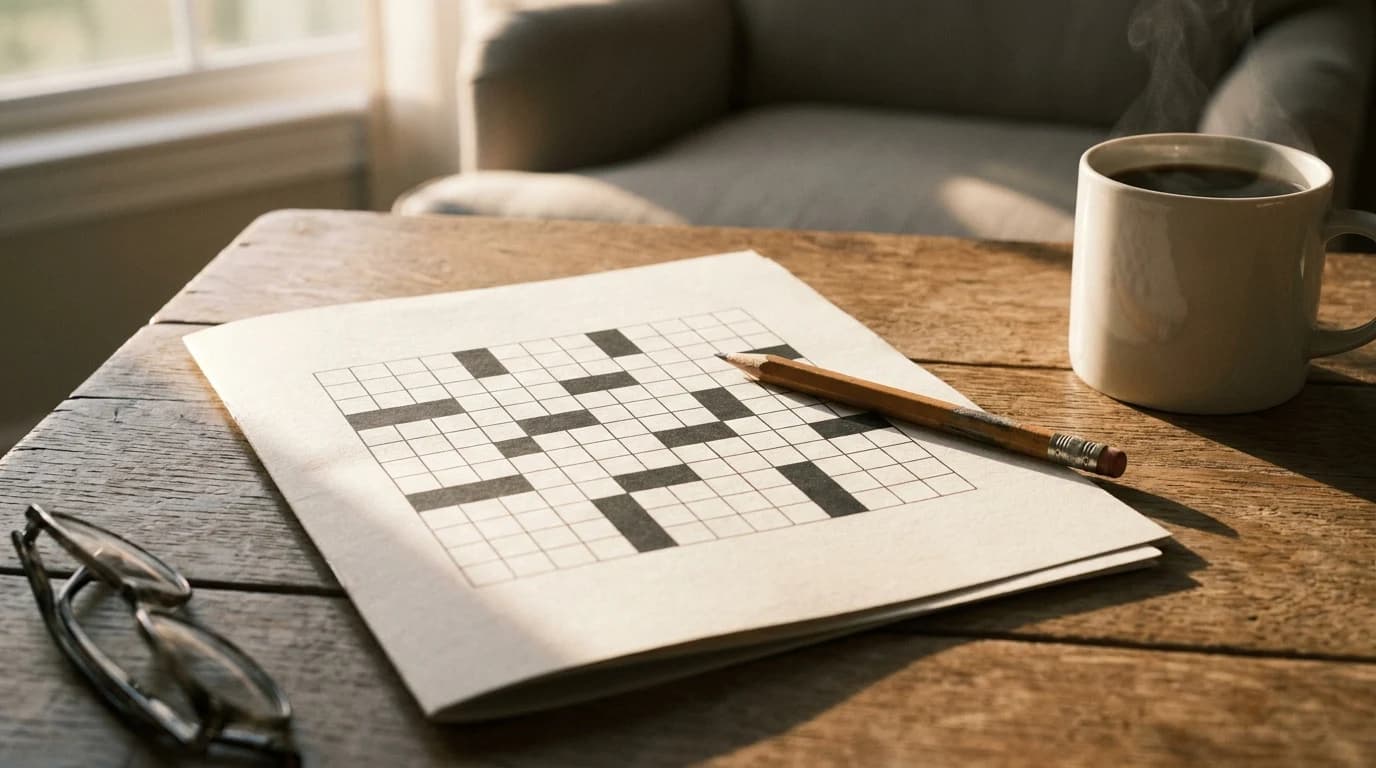
You have a crossword habit, or a Sudoku habit, or a parent who does one every morning and swears by it. The question underneath is always the same: is this doing anything, or is it a pleasant way to spend fifteen minutes?
The honest answer is that "puzzles are good for your brain" is four different claims wearing one coat, each backed by a different grade of evidence. Separating them changes what you should expect.
- 19,078adults aged 50 to 93 in the puzzle-frequency studyPROTECT, 2019
- 107people in the only crosswords-versus-games trialDevanand et al., 2022
- g = 0.22pooled effect of computerized training, 52 trialsLampit et al., 2014
The four claims hiding inside one sentence
Every puzzle headline is making one of these four arguments, and they are not interchangeable. The right-hand column is the part that never survives the summary.
| The claim | Strongest evidence for it | Design | What it cannot show |
|---|---|---|---|
| People who do puzzles have sharper cognition | 19,078 adults; all 14 cognitive measures favoured more frequent word-puzzle use, and the number-puzzle paper matched it | Cross-sectional online cohort, self-reported frequency | Direction. Sharper people may simply do more puzzles |
| Puzzles delay decline | Among 101 Bronx Aging Study participants who developed dementia, crossword participation went with a 2.54-year delay in accelerated memory decline | Prospective observational, 488 followed | Causation, and anything about preventing dementia itself |
| Crosswords beat brain-training games | 107 people with mild cognitive impairment; 78 weeks; crosswords superior on the primary outcome | Randomized, single-blinded, head-to-head | That either one beats doing nothing. There was no untrained group |
| Computerized training works | 52 randomized trials, 4,885 healthy older adults, a small but real pooled effect | Meta-analysis of randomized trials | Any gain in executive function or attention, where results were not significant |
The one head-to-head trial, and the detail that gets dropped
In 2022 a Columbia and Duke team ran the comparison everyone actually wants. Devanand and colleagues, in NEJM Evidence, randomly assigned 107 adults with mild cognitive impairment, average age 71, to twelve weeks of intensive home-based training on either crossword puzzles or cognitive games, then booster sessions out to 78 weeks.
The crosswords won on the primary outcome, ADAS-Cog, a scale on which a higher number means more impairment.
- Cognitive games (n = 51): the score drifted the wrong way, 9.53 to 9.93, with more hippocampal shrinkage and cortical thinning on MRI.
- Crosswords (n = 56): the score improved, 9.59 to 8.61 - a 1.44-point advantage - and daily functioning held up better at 78 weeks.
What predicted a benefit was not the puzzle
Widen to the whole randomized literature on computerized training in healthy older adults. Lampit and colleagues pooled 52 trials covering 4,885 people and found a small but significant overall effect, g = 0.22. The interesting part is the moderator analysis underneath it.
- Setting beat content. Home-based administration was ineffective compared with group-based training.
- More was not better. More than three sessions a week was ineffective versus three or fewer.
- The gains are uneven. Processing speed (g = 0.31) and visuospatial skills (g = 0.30) moved; executive function and attention showed no significant effect.
Set that beside the crossword trial and a falsifiable claim falls out: the best-supported variable here is not which puzzle you pick, it is whether the doing of it is structured and observed. The trial that produced a benefit monitored compliance weekly. The pooled trials that produced nothing were people training alone at home. That is the inverse of how brain-training products are sold - solo, daily, streak-driven. It is a reading across two studies rather than a tested claim, which makes it exactly the kind of claim one good trial could overturn.
Three questions to ask of any puzzle headline
- Randomly assigned, or just surveyed? The eye-catching totals - tens of thousands of people - come from surveys, and a survey cannot tell you which way the arrow runs.
- Compared with what? A trial with no untrained arm can only rank two activities against each other. Coverage quietly upgrades that into "puzzles work."
- Who was studied? Almost all of it is adults over 50, and the strongest trial ran in people already diagnosed with mild cognitive impairment. Nothing here was measured on a distracted thirty-year-old.
So should you keep doing the crossword
- Yes, if you like it. Enjoyment is the only thing that keeps a habit alive long enough for any of this to matter.
- Expect the gain to be narrow. You will get better at crosswords. Whether that carries anywhere else is the transfer problem, and it is why the brain-training industry lost that argument.
- Add a person if you can. The one moderator with real support points at doing it with someone, or with something watching the schedule.
- Three days a week is not the budget version. More than three sessions a week did no better than three or fewer.
- Do not trade it against better odds. An hour of puzzles is an hour not spent walking, and the exercise evidence is stronger.
Where the evidence stops
Crosswords and brain games FAQ
Are crosswords better than Sudoku for your brain?
Nobody has run that comparison. The word-puzzle and number-puzzle findings are two companion papers on the same survey population, reporting the same broad pattern; the two were never tested against each other. Pick whichever one you will keep doing.
Does a daily crossword prevent dementia?
No study shows that. The closest result is observational: among Bronx Aging Study participants who went on to develop dementia, crossword-doers reached accelerated memory decline about two and a half years later. That is a delay in a curve among people who still developed dementia, and it cannot separate the puzzles from whatever else distinguishes the people who do them.
Do puzzle apps count as brain training?
The distinction is marketing, not biology. The 2022 trial compared two computerized programs and the crosswords came out ahead - a reason to distrust anything that calls itself training on the strength of its interface. What separated the arms was the task, not the screen.
How much is enough?
There is no established dose, and the only relevant signal points away from cranking it up: in the pooled trial data, training more than three times a week was no better than three or fewer. Frequency is not where the returns are.
Sources
- Devanand, D. P., et al. (2022). Computerized Games versus Crosswords Training in Mild Cognitive Impairment. NEJM Evidence, 1(12).
- Columbia University Department of Psychiatry - Can Playing Crossword Puzzles Improve Cognitive Function? (trial design and the missing control group)
- Lampit, A., Hallock, H., & Valenzuela, M. (2014). Computerized cognitive training in cognitively healthy older adults: a meta-analysis of effect modifiers. PLoS Medicine, 11(11), e1001756.
- Brooker, H., et al. (2019). Frequency of word puzzle use and cognitive function in a large sample of older adults. International Journal of Geriatric Psychiatry, 34(7), 921-931.
- Brooker, H., et al. (2019). Frequency of number-puzzle use and baseline cognitive function in adults aged 50 and over. International Journal of Geriatric Psychiatry, 34(7), 932-940.
- Pillai, J. A., et al. (2011). Association of crossword puzzle participation with memory decline in persons who develop dementia. Journal of the International Neuropsychological Society, 17(6), 1006-1013.
- National Academies of Sciences, Engineering, and Medicine (2017). Preventing Cognitive Decline and Dementia: A Way Forward.
Ready to get unstuck?
The Brain Deck gives you 52 science-backed strategies in your pocket — a physical card deck you keep on your desk, no app required.
See the CardsLaunching soon · 54 cards · Premium matte finish