Why a Walk Outside Resets Focus, and How Little It Takes
The arboretum walk in the famous study bought about one extra digit of working memory over the city walk. Here is what that number means, what it was not caused by, and how small a dose has actually been tested.
By The Brain Deck Editorial
In the study everyone cites, the nature walk bought about one extra digit of working memory over the city walk: real, replicated and smaller than the headlines. Ten minutes of nature photographs or sounds produced an effect too.
Key Takeaways
- The effect is one digit - the arboretum walk improved backwards digit span by 1.50 digits, the equal-length downtown walk by 0.50. Real, replicated, and smaller than the headlines suggest.
- It was not the mood, the weather, or the exercise - both walks were 2.8 miles, month of testing made no difference, and mood changes did not correlate with the score.
- Ten minutes of photographs worked too - so did nature sounds, which is the lowest dose with published evidence behind it.
- The wins are narrow - working memory and cognitive flexibility improve reliably; impulse control, vigilance and processing speed do not.
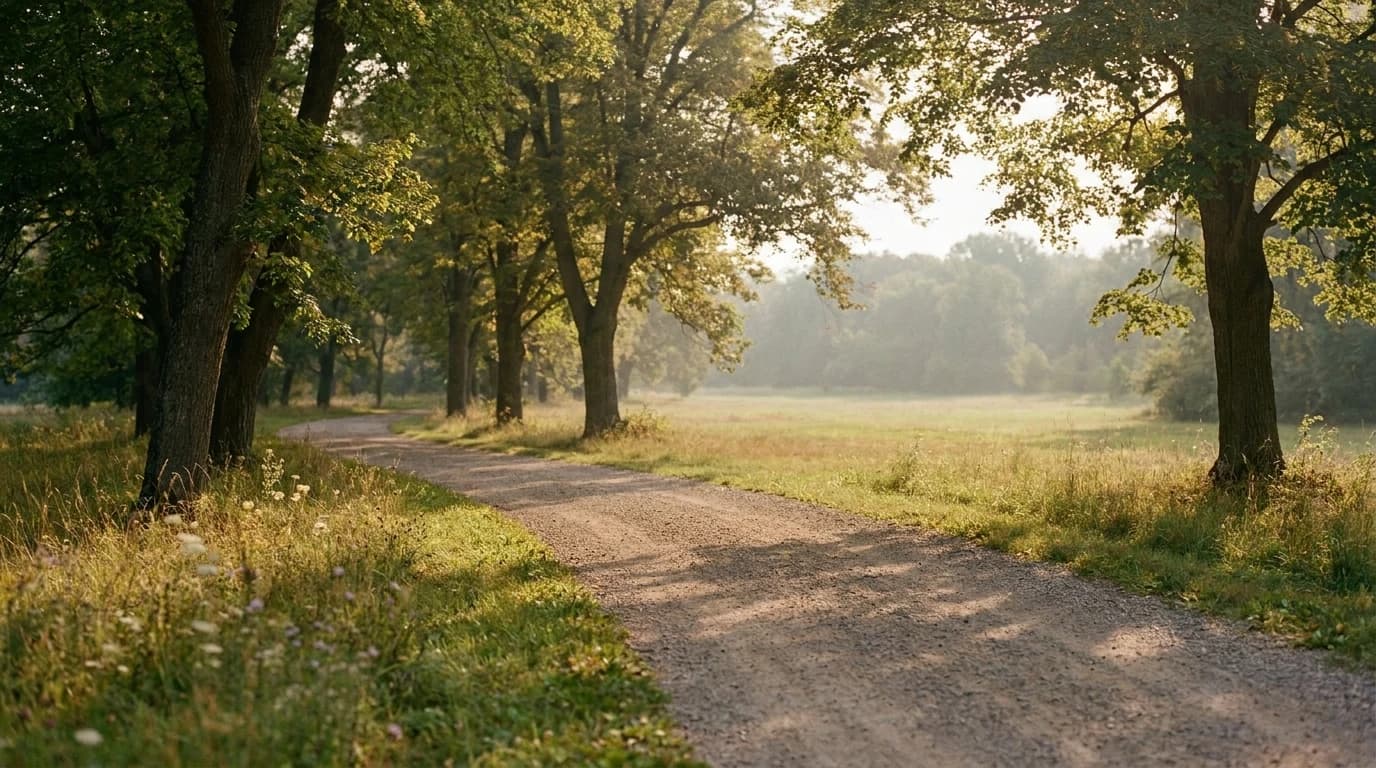
The most-cited experiment behind “go for a walk” produces a number, and the number is one digit. In Berman, Jonides and Kaplan's 2008 study in Psychological Science, students who walked through an arboretum came back able to hold about 1.5 more digits in reverse than before they left. Students who walked the same distance downtown gained 0.5. That gap is the entire famous finding.
Small is not fake, and it is not useless. But it sets the expectation, and it makes a better question answerable: what in that walk did the work? The paper spends most of its length ruling things out, and that list is the useful part.
What the arboretum walk actually bought
Thirty-eight University of Michigan students had their attention deliberately worn down first - a directed-forgetting task, 144 trials, 35 minutes - then walked one of two predefined routes with a map and GPS watch. One was tree-lined and secluded from traffic; the other ran along traffic-heavy Huron Street. Both were 2.8 miles. A week later each walked the other one, repeating the test: hear a string of numbers, say it back in reverse.
| Setting | Backwards digit span before | After | Change |
|---|---|---|---|
| Arboretum walk | 7.90 | 9.40 | +1.50 digits |
| Downtown walk | 7.90 | 8.40 | +0.50 digits |
Only the arboretum gain was statistically reliable.
Four explanations the study eliminated
- Not the mood lift. Mood improved more after the nature walk, but the change did not correlate with the change in digit span (r = .206 after nature, r = .029 after downtown). A pooled analysis of 13 experiments, N = 528, agreed: affect did not mediate the effect.
- Not the weather. Testing ran across September, November, January and July. The month had no reliable effect.
- Not the peace and quiet. In the paper's second experiment both conditions happened in the same quiet lab room. Only one worked.
- Not practice at the test. Walk order made no difference, so this was not people simply getting better at digit span.
One rating did track performance: how refreshing people judged the walk (r = .41, baseline partialled out). How much they enjoyed it did not - in the second experiment they rated the nature images more enjoyable and liked them more, and neither predicted their scores. Refreshing and enjoyable are not the same variable.
- 1.50 vs 0.50digits gained on backwards digit span, arboretum walk versus downtown walkBerman et al., 2008
- ~10 minof nature photographs in a lab, which moved the same scoreBerman et al., 2008, Exp. 2
- 3 of 13meta-analyses in a 31-study review that found a marked benefitOhly et al., 2016
How little counts as nature
The second experiment is the part most retellings drop, and it decides whether this is usable on a Tuesday. Twelve participants sat in a quiet room and viewed 50 photographs - Nova Scotia scenery in one session, Ann Arbor, Detroit and Chicago in the other - for 7 seconds each, about 10 minutes total. Digit span improved reliably after the nature pictures, not the urban ones. The doses actually tested therefore run from a screenful of trees to a ninety-minute hike:
| Dose that was tested | The exact exposure | What moved | What did not |
|---|---|---|---|
| Photographs | 50 images, 7 s each, ~10 min, quiet room | Backwards digit span; the executive portion of an attention test | Alerting and orienting attention; mood did not change at all |
| Sound only | Natural versus urban soundscapes | Backwards digit span and a dual n-back task | Positive or negative affect |
| A 50-55 minute walk | Arboretum versus downtown, both 2.8 miles | Backwards digit span, +1.50 versus +0.50 digits | Mood change did not predict it; season did not affect it |
| A 90-minute walk | Natural versus urban setting, 5.3 km | Self-reported rumination and subgenual prefrontal activity | Attention was not the outcome measured here |
The sound row is Van Hedger and colleagues (2019); the ninety-minute walk is Bratman and colleagues (2015, PNAS), which measured rumination rather than attention.
Where the effect stops
Ohly and colleagues' 2016 systematic review pooled 31 studies across thirteen meta-analyses. Three found a marked beneficial effect - digit span forward, digit span backward, and Trail Making Test B. The other ten did not, and the authors flag small samples and heterogeneous reporting as limits.
Schertz and Berman's 2019 review in Current Directions in Psychological Science draws the boundary from the other side: working memory and cognitive flexibility improve most reliably, while impulse control, visual attention, vigilance and processing speed have not reliably shown differences.
The condition almost nobody mentions
Attention restoration theory, as Stephen Kaplan set it out in 1995 and as Schertz and Berman restate it, does not say “trees.” It says a restorative setting offers soft fascination plus three other properties: a sense of being away, enough extent to feel explorable, and compatibility with what you are trying to do.
Compatibility quietly decides whether your walk works. Their example: a walking commute through a park is unlikely to feel restorative on the days you are running late. Same park, same trees, same duration, no restoration. The shape of the space matters too - walks with high prospect, an open field of view, produced more restoration than enclosed ones. So the practical question is not how long but under what conditions.
- Go without a destination. A timed errand carries the deadline with you, which is why a break spent watching the clock does not land.
- Take the open route over the enclosed one.
- Leave the podcast off sometimes. Nature sounds alone improved working memory; a talk feed re-occupies the faculty you are resting. Movement micro-breaks cover what fits between meetings.
- Do not save it for holidays. Photographs worked indoors in ten minutes - a far lower bar than the annual unplugged week.
Walking outside and focus: FAQ
How long does the walk need to be?
The experiment everyone quotes used 50 to 55 minutes, but the same paper got a reliable improvement from about 10 minutes of nature photographs. No study has established a minimum, so treat 10 minutes as the shortest exposure with published evidence behind it, not as a threshold.
Does it still work if I do not enjoy it?
Probably. Enjoyment and liking ratings did not correlate with performance in Berman's second experiment, and mood did not mediate the effect across 13 pooled experiments. How refreshing people found the walk did track their scores - a different judgement from how pleasant it was.
Do photos or videos of nature count?
For the measured working-memory effect, images and sounds both produced reliable improvements. That is a claim about one narrow task, not that a screensaver equals a forest. A real walk also buys daylight and movement.
Sources
- Berman, M. G., Jonides, J., & Kaplan, S. (2008). The cognitive benefits of interacting with nature. Psychological Science, 19(12), 1207–1212.
- Stenfors, C. U. D., et al. (2019). Positive effects of nature on cognitive performance across multiple experiments. Frontiers in Psychology, 10, 1413.
- Ohly, H., et al. (2016). Attention restoration theory: a systematic review. J. Toxicol. Environ. Health B, 19(7), 305–343.
- Schertz, K. E., & Berman, M. G. (2019). Understanding nature and its cognitive benefits. Current Directions in Psychological Science, 28(5), 496–502.
- Van Hedger, S. C., et al. (2019). Of cricket chirps and car horns: nature sounds and cognitive performance. Psychonomic Bulletin & Review, 26(2), 522–530.
- Bratman, G. N., et al. (2015). Nature experience reduces rumination and subgenual prefrontal cortex activation. PNAS, 112(28), 8567–8572.
Ready to get unstuck?
The Brain Deck gives you 52 science-backed strategies in your pocket — a physical card deck you keep on your desk, no app required.
See the CardsLaunching soon · 54 cards · Premium matte finish