Analog Hobbies, Ranked by What They Do for Your Attention
Screen-free is not the useful axis. Some analog hobbies refund attention and some spend it. Here are sixteen sorted by attention mode, plus which to reach for when.
By Hilly Shore Labs
Key Takeaways
- Sort by attention mode, not by screens. Restorative hobbies hold you effortlessly and let a depleted resource recover; training hobbies like chess spend that same resource. A jigsaw and a chess clock are not interchangeable.
- Restoration is not only a nature thing. In a 2025 within-subject study a museum visit improved attentional control more than an urban walk, so an absorbing, low-stakes indoor hobby counts too.
- The phone-in-another-room rule is the least settled claim here. A pre-registered replication found no effect of phone location at all, while a meta-analysis of 22 studies finds a real but heterogeneous effect.
- The craft-and-wellbeing evidence is cross-sectional. The largest recent survey linked more crafting to better mental health, but its own author ranks age, financial security and occupation as more important.
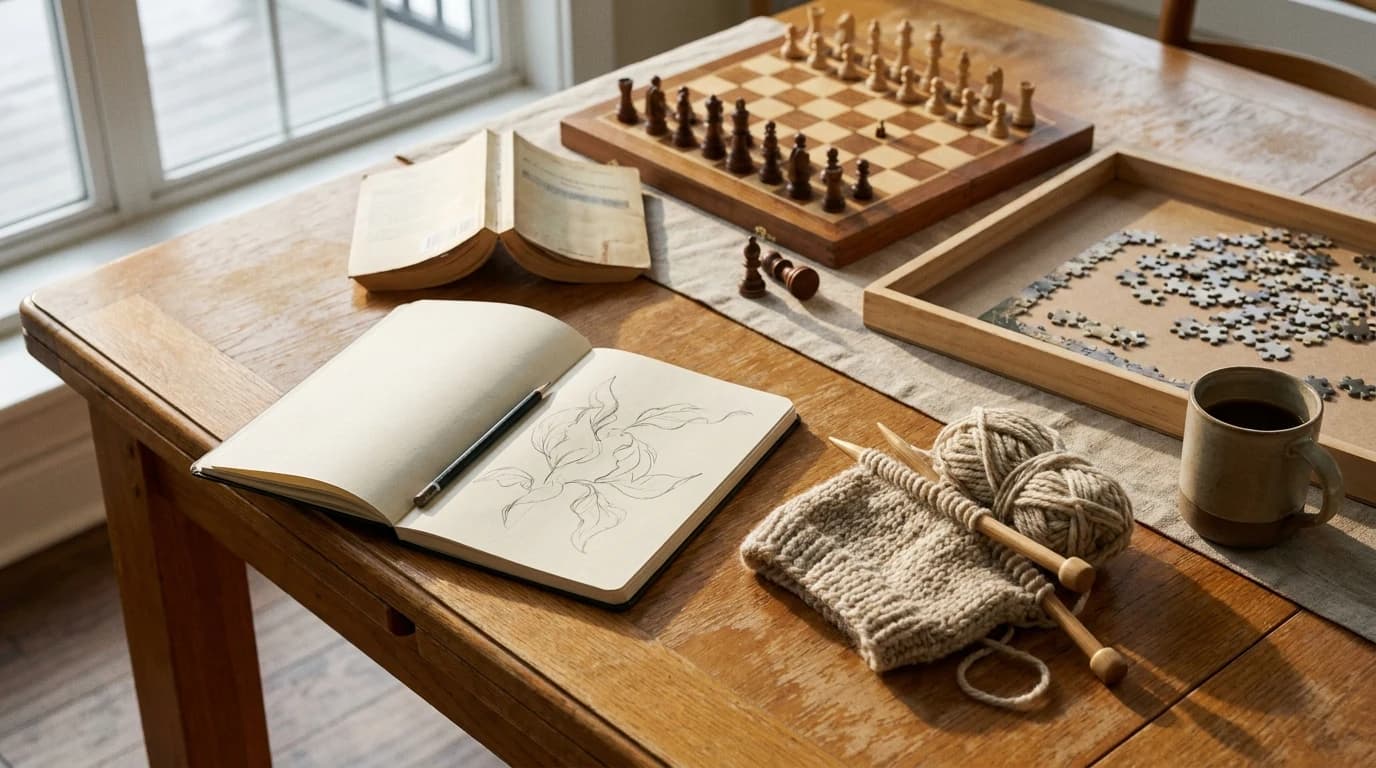
Every "50 analog hobbies" list treats screen-free as the whole point, as though a jigsaw and a chess clock did the same thing to a tired brain. One refunds attention. The other spends it. Pick wrong at 9pm and the evening ends more fried than it started.
Short answer: sort hobbies by what they ask of your attention, not by whether a screen is involved. Some hold you effortlessly and let a depleted resource recover. Some train focus, which is worth doing but is not rest.
Three things a hobby can do to your attention
Attention Restoration Theory rests on a claim that is easy to state and easy to forget: the effortful, steered attention you point at a spreadsheet is a limited resource, and it runs down. A 2018 systematic review of 42 studies found that exposure to natural environments improved working memory and cognitive flexibility at low-to-moderate effect sizes, and that real environments beat virtual ones. Kaplan's name for the ingredient is soft fascination — something that holds you without you having to hold it — and a 2024 conceptual review extends the idea past nature to designed environments.
- 🌿RestoreHolds you effortlessly. No score, no deadline, nothing to get wrong.
- 🎯TrainDeliberately hard. Builds the skill, spends the resource.
- 🔨FlowSkill meets feedback. Restorative in feel, taxing in fact.
- 👥SocialThe demand is other people. Fixes isolation, not depletion.
Sixteen analog hobbies, sorted by what they ask
"Mins to feel it" is where the activity stops feeling like a chore you assigned yourself. "Phone risk" is how easily it pulls the phone back in: a tuner, a recipe, a pattern video, an app opponent.
| Mostly restorative | Why | Start-up | Mins to feel it | Phone risk |
|---|---|---|---|---|
| Walking with no phone | Cleanest soft-fascination case, best studied | Free | 10 | Low |
| Gardening | Slow feedback, no failure state | Low | 15 | Low |
| Jigsaw puzzles | Self-paced; impossible to fall behind on | Low | 15 | Low |
| Knitting or crochet | Restorative after the pattern goes automatic | Low | 20 | High |
| Birding | Soft fascination with a search task on top | Medium | 20 | Medium |
| Reading paper fiction | Dense non-fiction is training in the same jacket | Low | 15 | High |
| Letter writing | Slow, one recipient, no metrics | Very low | 10 | Low |
| Card or prompt decks | A nudge, not a session. Disclosure: we make one | Low | 1 | Low |
| Training, flow or social | Why | Start-up | Mins to feel it | Phone risk |
|---|---|---|---|---|
| Chess and strategy games | Directed attention under load. Not a break | Low | 20 | High |
| Mechanical puzzles | Training in bursts, with an end state | Low | 10 | Low |
| Instrument practice | Training on a passage, flow once you play | Medium | 20 | Medium |
| Sketching or drawing | Flow, forgiving of a bad day | Very low | 15 | Medium |
| Cooking from a written recipe | Flow with a deadline; the card off the screen is the trick | Low | 20 | High |
| Woodworking | Flow with real consequences. Demanding | High | 30 | Low |
| Film photography | Flow stretched over days. Delayed feedback | High | One roll | Low |
| Board game night | Social first. Neutral for attention | Low | 30 | Medium |
Pick by the problem you actually have
| What is wrong | Reach for | Because |
|---|---|---|
| Cannot wind down at night | Knitting, jigsaw, paper fiction | No scorekeeping, and you can stop mid-row without losing anything |
| Focus gone by 2pm | Phoneless walk, gardening, birding | Depletion, not weakness. Training something harder makes it worse |
| Reaching for the phone reflexively | Sketching, mechanical puzzles, a card deck | The hand needs an object fast. A 15-minute warm-up loses to the phone |
| Weeks of talking to nobody | Game night, a class, letter writing | Social is its own axis. Solo restorative time will not touch it |
The line everyone repeats is the least settled thing here
Every list closes by telling you to put the phone in another room, citing the "brain drain" finding that a phone on the desk costs you capacity even switched off. That is the shakiest claim in the file.
- 22studies, 43 effects pooled: a real negative effect, but heterogeneous across domains2023 meta-analysis
- 0difference between phone on the desk, in a bag, or out of the roomPre-registered replication
- 1separate experiment did find worse attention with a phone merely presentScientific Reports, 2023
What the craft-and-wellbeing numbers can and cannot show
The other repeated line is that making things with your hands is good for you. The largest recent dataset surveyed 6,756 Swedish women who identify as handicrafters, and found that those who craft more often, or have done it longer, report better mental health.
Several other factors — age, financial security, occupation, and everyday activities — were more important for mental health than handicraft.Sundbeck, Issues in Mental Health Nursing, 2026
That is the study's own conclusion, and a cross-sectional survey cannot separate "crafting helped" from "people with the time to craft for years were already doing better." Treat the wellbeing claim as unproven and pick for attention mode instead — that is the part with experiments behind it. A 2025 experiment on restoration without visual nature earns the same caution: physiological recovery appeared with or without the visual channel, and no condition produced a significant cognitive difference.
A two-week version that survives contact with a Tuesday
Two hobbies, twenty minutes, one rule
- One restorative and one training hobby — not two of either. The restorative one is load-bearing; the training one is for a morning when you have something to spend.
- Twenty minutes, four evenings. Short enough to survive a bad day, long enough to stop feeling assigned.
- Phone in another room — not because the evidence is settled, but because it removes the decision instead of asking you to win it.
- Week two, change nothing. Judge it by whether you reached for it unprompted, not by output.
For the mechanism, the screen-free reset post covers how analog play restores focus, and the walking research shows how small a tested dose can be. If your instinct was a brain-training app, the one head-to-head trial is worth ten minutes first.
Analog hobbies FAQ
Is reading on a Kindle an analog hobby?
For attention purposes, close enough. A single-purpose reader with no notifications asks the same thing of you as a paperback. What matters is not paper versus screen but whether the device can interrupt you, so a phone reading app is a different activity.
Do analog hobbies improve focus at work?
Indirectly, and only the restorative ones. The evidence supports recovering a depleted resource, not raising your baseline. The systematic review above found the improved domains were working memory and cognitive flexibility, at low-to-moderate effect sizes.
How long before a new hobby actually helps?
Within a single session, if you picked a restorative one. Most people notice something in 10 to 20 minutes, which is why the plan above is twenty. Whether it survives as a habit is a longer question.
Which analog hobby is best for anxiety?
None of this is treatment, and persistent anxiety is worth raising with a clinician. Generally people do better with low-stakes restorative options than with anything scored or timed. Journaling is worth watching: for some it becomes a place to rehearse the worry rather than set it down.
Sources
- Stevenson et al. (2018) — Attention Restoration Theory II.
- Vasta & Biondi (2025) — Restoration in museums.
- Sakimura et al. (2025) — Restoration without visual nature.
- Sundbeck (2026) — Does handicraft provide better mental health?
- Böttger et al. (2023) — Brain-drain meta-analysis.
- Ruiz Pardo & Minda (2022) — Ward et al. replication.
- Skowronek et al. (2023) — Mere smartphone presence.
- Pham & Sanocki (2024) — Restoration and flow.
Ready to get unstuck?
The Brain Deck gives you 52 science-backed strategies in your pocket — a physical card deck you keep on your desk, no app required.
See the CardsLaunching soon · 54 cards · Premium matte finish