How to Build a Memory Palace (and What It's Good For)
Pick a route you know, fix five to ten spots, place a vivid image on each, then walk it back. A worked grocery example, the research, and its limits.
By The Brain Deck Editorial
To build a memory palace, pick a route you can walk with your eyes shut, fix five to ten spots along it in order, turn each item into a vivid image and place one per spot, then walk the route back in your head. Controlled trials show real recall gains for ordered lists; pair it with spaced repetition for anything you need to keep.
Key Takeaways
- Five steps build a palace. Pick a familiar route, fix five to ten loci in order, make vivid images, place one per spot, then walk it back.
- The evidence is real but rough. A 2021 meta-analysis of 13 trials found a medium effect on recall; the trials carried a high risk of bias.
- It is built for order. The strongest result is for recalling a list in sequence soon after learning it, not for understanding ideas.
- Pair it with spaced repetition. Use the palace to learn a list fast, then review it on cards so it lasts.
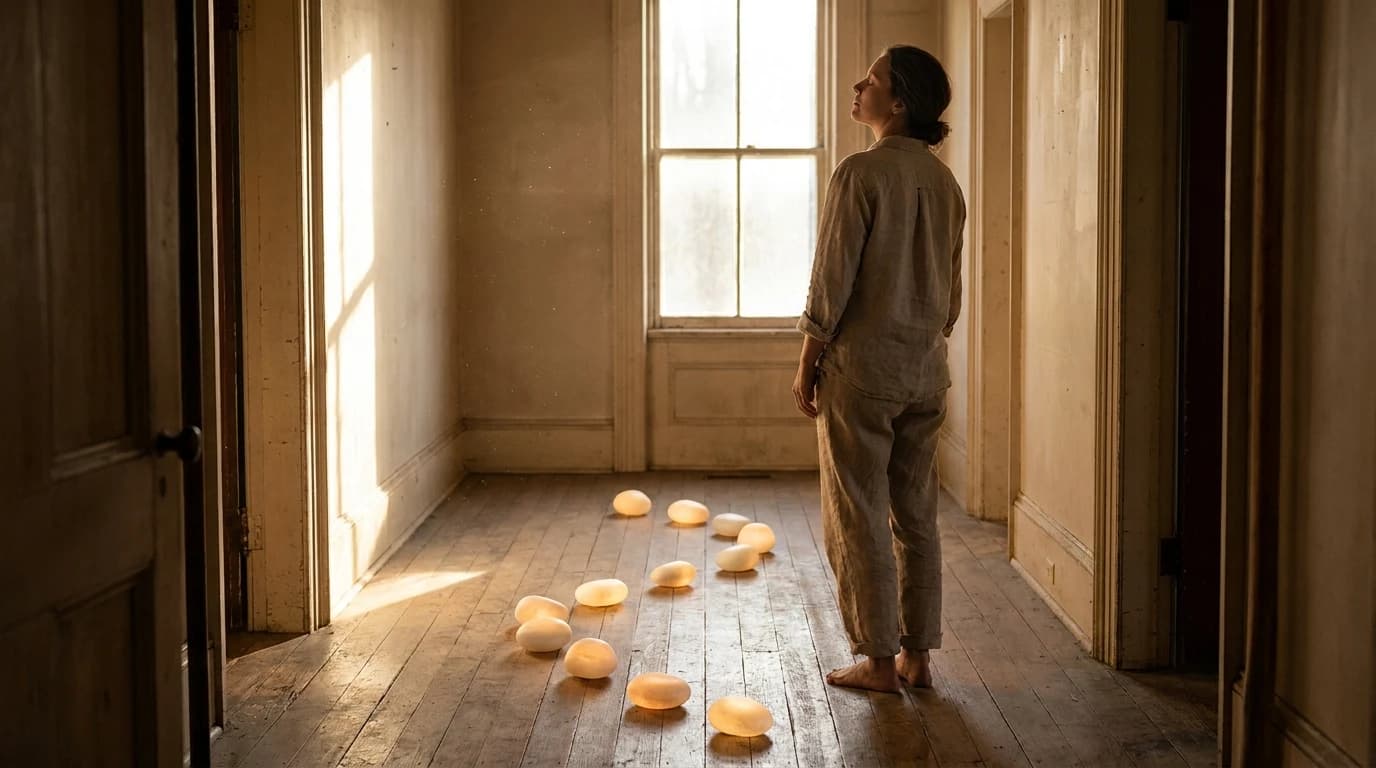
To build a memory palace, pick a place you can walk through with your eyes shut, fix five to ten spots along the route in a set order, turn each thing you need to remember into a strange, vivid image, and leave one image at each spot. To recall, walk the route again in your head. It is excellent for ordered lists and weak for understanding.
The technique is also called the method of loci, and it is old: Twomey and Kroneisen's 2021 meta-analysis notes it has been used for thousands of years and by many successful memory athletes. What forums rarely add is how well it holds up in controlled studies.
- 13randomized trials pooled, mostly at universitiesTwomey & Kroneisen, 2021
- g = 0.65a medium effect on recallTwomey & Kroneisen, 2021
- 6 weeksof mnemonic training shifted novices' brain networksDresler et al., 2017
Build your first palace in five steps
Step 1: Choose a route you already own
Your home, your commute, the walk from the car park to your desk. The place must cost you zero effort to picture, or you end up memorizing the palace as well as the list.
Step 2: Fix five to ten loci in order
Pick distinct spots you pass in a fixed direction: front door, coat hook, sofa, sink. Walk it twice in your head and say them aloud. Same order, every time.
Step 3: Turn each item into an image
Make it big, wrong, moving or loud. "Milk" is forgettable; a sofa sloshing with milk as you sit down is not.
Step 4: Place one image per locus
Make the image interact with the spot. An egg near the door fades; eggs cracking down the door, yolk on the handle, sticks.
Step 5: Walk it back
Close your eyes, start at the first locus and read off each image. Anything missing points to a weak image, so redo that one.
A worked example: eight groceries, one apartment
Here is a real list placed along a route through an ordinary home. The images are deliberately ridiculous; that is the job.
| Locus (room) | Item | The image you place |
|---|---|---|
| 1. Front door | Eggs | Eggs smashed down the door, yolk dripping off the handle |
| 2. Hallway coat hook | Bananas | A bunch of bananas hanging there, wearing your scarf |
| 3. Sofa | Milk | The cushions are full of milk; you sit and it splashes up |
| 4. TV | Spinach | Wet spinach leaves plastered over the screen |
| 5. Kitchen tap | Coffee | You turn it on and hot black coffee pours out |
| 6. Fridge | Batteries | The fridge door sparks; batteries cling to it like magnets |
| 7. Stove | Bread | A loaf in an oven mitt, stirring a pot |
| 8. Back door | Dish soap | Bubbles foaming under the door; you slide through them |
In the shop, walk the apartment in your head: door, hook, sofa, TV, tap, fridge, stove, back door. The same route works for a talk: put your opening point on the door, the second on the hook, and you never need notes to know what comes next.
Check your palace before you trust it
- You can name every locus forwards without the list in front of you.
- You can name them backwards too, which proves the order is fixed.
- Each image interacts with its spot, not just stands beside it.
- No two loci look alike (two identical doors will swap images).
- You have walked it back once, a few hours later, from cold.
What the research actually shows
Three sources carry most of the weight. Each figure below comes from the paper's abstract.
| Study | What it looked at | What the abstract reports | The catch |
|---|---|---|---|
| Twomey & Kroneisen, 2021 | Meta-analysis of 13 randomized trials, mostly university-based | A medium effect (g = 0.65) that held after adjusting for publication bias and outliers | High risk of bias: most trials did not report how they randomized |
| Ondřej, 2025 | Systematic review and meta-analysis in adults | A large effect on immediate serial recall versus rehearsal (d = 0.88); activity in spatial and navigation areas such as the hippocampus | Evidence rated low to very low quality |
| Dresler et al., 2017 | 23 memory athletes vs matched controls; novices given 6 weeks of mnemonic training | Training shifted novices' brain connectivity toward the athletes' pattern, and that similarity predicted memory gains up to 4 months later | A brain-network study; the abstract gives no size for the recall gain |
Read together: the effect on remembering a list in order is real and sizeable, it lines up with the brain's navigation machinery, and six weeks of training moved novices' brain networks toward the memory athletes' pattern. The quality of the individual trials is the weak link.
What it is good for, and what it isn't
A palace stores sequence and retrieval cues. It does not store meaning, and it does not schedule its own review. That is where spaced repetition takes over.
Use a memory palace for
- Shopping and packing lists
- The order of points in a talk
- Steps in a fixed procedure
- A set of names to learn today
Use spaced repetition for
- Vocabulary you need next year
- Facts you must recall in any order
- Exam material over weeks
- Anything you are still trying to understand
The two combine well: build the palace to learn a list fast, then put the list on cards and review it on a spacing schedule. For faces rather than lists, the 60-second name fix uses the same vivid-image trick.
When the palace leaks
| Symptom | Likely cause | Fix |
|---|---|---|
| A locus comes up empty | The image was too plain | Rebuild it with motion, sound or scale |
| Items come out in the wrong order | The route has no fixed direction | Walk it one way only, and number the loci |
| Two items blur together | Two loci look alike | Swap one for a more distinct spot |
| Old lists bleed into new ones | One palace doing every job | Keep a second route for a second list |
Is this just a brain game?
No. Brain games train the game; the evidence on what they transfer and the crossword trial is thin. A memory palace is a strategy you apply to things you actually need to remember, which is why it earns its place in a toolkit.
If your head is full before you even start, empty it first with a brain dump, then decide which items deserve a palace. The Brain Deck works on the same principle of one concrete action at a time; here is how it works.
Memory palace FAQ
How many loci should my first palace have?
Five to ten. Enough to hold a real list, few enough to walk in under a minute while you learn the method.
Should I use a real place or an imagined one?
Start with a real one. The whole trick is a route you already know without effort; an invented building has to be memorized too.
Sources
- Twomey, C., & Kroneisen, M. (2021). The effectiveness of the loci method as a mnemonic device: Meta-analysis. Quarterly Journal of Experimental Psychology.
- Ondřej, J. (2025). The method of loci in the context of psychological research: A systematic review and meta-analysis. British Journal of Psychology.
- Dresler, M., et al. (2017). Mnemonic training reshapes brain networks to support superior memory. Neuron.
Tools that help with this
Ready to get unstuck?
The Brain Deck gives you 52 science-backed strategies in your pocket — a physical card deck you keep on your desk, no app required.
See the CardsLaunching soon · 54 cards · Premium matte finish