What Is NSDR? What Non-Sleep Deep Rest Can Actually Do
NSDR is awake, guided rest, mostly yoga nidra under a new name. Here is each popular claim checked against its source, including the 65% dopamine figure.
NSDR (non-sleep deep rest) is a guided relaxation done lying down and awake, a term Andrew Huberman coined for practices like yoga nidra. Research supports a modest drop in stress and possible sleep benefits. No study supports claims that 30 minutes replaces hours of sleep, and the one nap comparison we found favored the nap.
Key Takeaways
- It is mostly yoga nidra renamed. Most of the evidence comes from yoga nidra trials, and only a few studies use the NSDR label.
- The 65% dopamine figure is an inference. It comes from a 7.9% binding drop in one small PET study, and relaxation depth did not differ.
- It does not replace sleep. No traceable study supports the 2-hour claim, and in the one head-to-head trial we found, a nap beat NSDR.
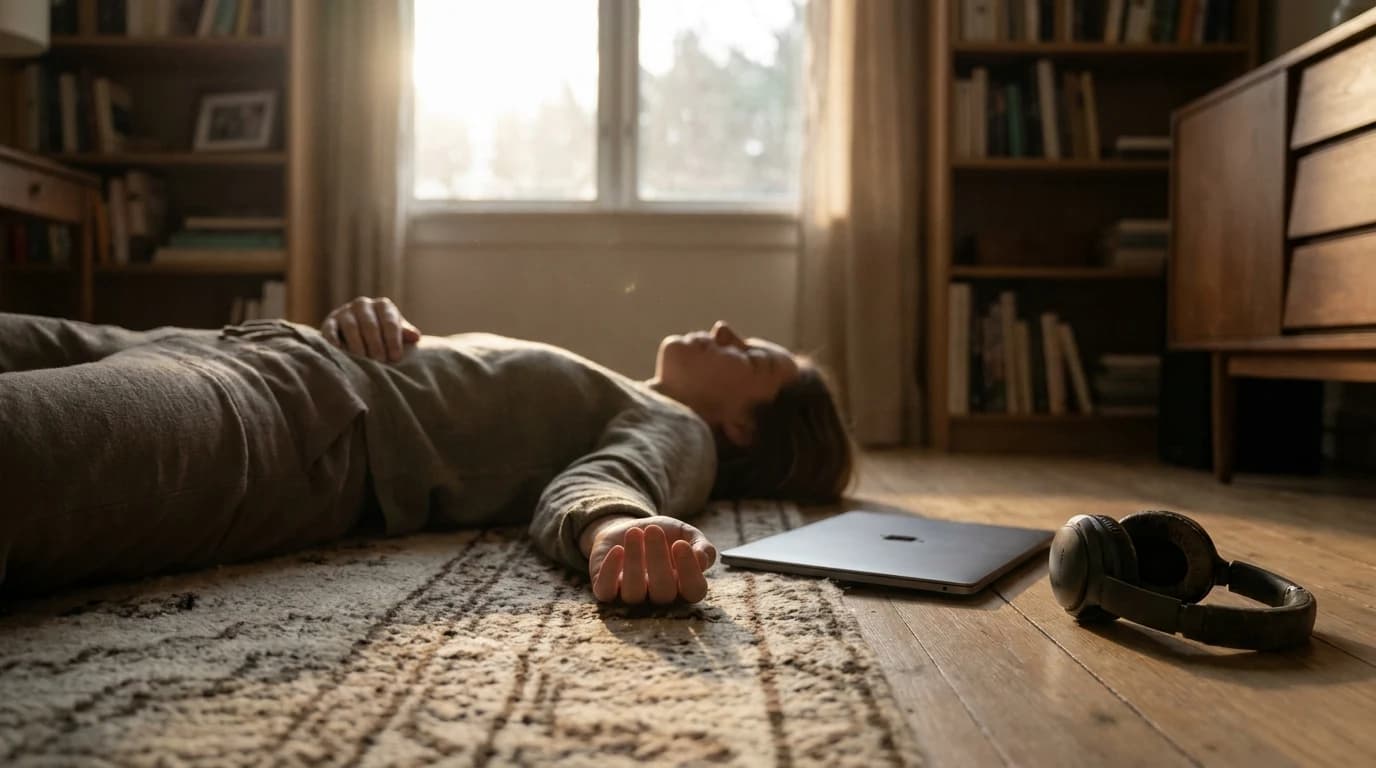
NSDR, or non-sleep deep rest, means lying still with your eyes closed and following a guided script while you stay awake. It is a new name for an old practice, mostly yoga nidra. The research supports it as a modest way to lower stress. It does not support it as a replacement for sleep, and the one head-to-head trial we found favored a nap.
- 7.9%The drop actually measured in the PET scan behind the famous 65% dopamine figureKjaer et al., 2002
- d 0.08 to 0.16Effect sizes for 11 minutes of online yoga nidra against a waitlist, over two monthsMoszeik et al., 2025
- 0Studies we could trace behind "30 minutes equals 2 hours of sleep"Worldcrunch on the claim
Where the name came from
Stanford neuroscientist Andrew Huberman says on his own site that he coined the term for practices that bring deep relaxation without full sleep, including yoga nidra and some forms of meditation. The Sleep Foundation describes it as a friendlier label for yoga nidra, whose spiritual associations might put some people off.
That matters when you read the evidence. Most studies quoted in NSDR articles looked at yoga nidra, often longer sessions in people with a diagnosis. Only a few trials have used the NSDR name, even though RISE's popular guide says none exist.
The evidence ledger
Here is each popular claim, set against what its source says. The strength ratings are our own judgment.
| Claim | What was measured | Strength |
|---|---|---|
| 30 minutes equals 2 hours of sleep | Nothing we could trace. Sleep researcher Dieter Riemann points out the lack of proof. | None |
| Raises dopamine 65% | One PET study: tracer binding in the ventral striatum fell 7.9%, which the authors convert to 65%. | Weak |
| Less tired and stressed right after | 102 young adults, 10 minutes: lower sleepiness, fatigue and stress, with small effects. A 60-person trial found no significant effect. | Mixed |
| Works as well as a nap | 25-minute nap opportunity vs 10-minute NSDR, 20 per group: only the nap lowered fatigue against control. | Against, one small trial |
| Sharper thinking | Reaction time improved immediately, then no difference at later checks. A before-and-after study saw better task accuracy after weeks of practice. | Weak |
| Better night sleep | Six trials, 244 people: mostly positive, moderate to high risk of bias. A 2026 meta-analysis rates certainty very low. | Promising, unproven |
| Lower stress and anxiety | 73 studies, 5,201 people: significant benefits, but the authors call the estimates likely inflated. | Moderate, smaller than headlines |
| Part of your brain sleeps | 26 novices were scored awake throughout, with local slow waves in one area. | Early |
What the 65% dopamine number really says
This is the most repeated figure in the topic. Huberman's page links it to an hour-long session and a rise of up to 65% in baseline dopamine. The 2002 paper is more specific, and three details rarely make it into the retelling:
- The 65% is calculated. The scanner saw a 7.9% fall in raclopride binding. The tracer competes with dopamine, so the authors infer the release from that fall.
- The comparison was not doing nothing. Participants were scanned during meditation and while attending to speech with their eyes closed.
- Relaxation did not differ. Depth of relaxation and level of gratification were the same in both conditions. The change was in reduced desire for action.
So it is an interesting finding about one brain region in a small study. It does not show that a session replenishes your dopamine or leaves you more motivated afterward.
The trials that actually say NSDR
Two come from one research group, both in physically active people around 22 years old. In the larger one, 51 people did 10 minutes of NSDR and 51 did a control. The NSDR group reported less sleepiness, fatigue and stress, and the authors call the physiological findings modest. In the smaller one, NSDR showed no significant effects at 20 per group, while a nap improved fatigue and readiness 40 minutes later.
The Sleep Foundation still says no direct nap comparison exists. This 2026 trial is the first we found, and one small study in fit young adults will not settle it. A third, a pilot of 45 heart patients in cardiac rehab, found eight NSDR sessions reduced anxiety and stress scores about as well as virtual reality therapy.
Can it replace sleep?
No. The Sleep Foundation says plainly it is not a replacement, and Riemann argues sleep cannot be replaced or compensated for this way. Huberman is more careful in conversation than the claim made in his name. Asked whether you can recover lost sleep, he answers "We don't know" and labels his own feeling of being rested after a session as anecdote.
The sleep lab results fit that caution. Thirty minutes of yoga nidra in 22 adults with insomnia did not change sleep onset, only breathing rate. If you have been running short for days, our guide to sleep debt and attention explains why feeling fine is a poor gauge.
What to reach for
| Your situation | Better first move |
|---|---|
| Afternoon slump, 30 minutes free, somewhere to lie down | A short nap. See why you crash at 3pm. |
| Ten minutes free, or naps leave you groggy | NSDR. Low cost, modest expected return. |
| Racing thoughts at bedtime | A longer session, plus these steps for when your mind won't shut off. |
| Short on sleep several nights running | More sleep. NSDR is the extra, not the fix. |
How to try it for two weeks
Step 1: Pick one recording
Huberman offers free 10, 20 and 30-minute versions, and any guided yoga nidra track covers the same ground. Don't switch daily.
Step 2: Lie down and close your eyes
The protocol in the 102-person trial used slow breathing and moving attention through the body in sequence. That is the whole technique.
Step 3: Start at 10 to 11 minutes
An online trial assigned people to 11 or 30 minutes, ideally daily, for two months. The 11-minute version beat a waitlist, with small effects.
Step 4: Rate yourself and compare
Score your energy and stress from 1 to 10 before and after. On a few days, swap in a nap or a walk outside, and keep whatever scores best.
NSDR questions
Is NSDR the same as yoga nidra?
Mostly. Huberman's definition is wider and also takes in some meditation. A yoga nidra recording is a fair way to try it, and it is what most of the research used.
Does NSDR count as sleep?
No. In the sleep lab study of novices, every session was scored as awake, even with slow waves appearing locally.
Ready to get unstuck?
The Brain Deck gives you 52 science-backed strategies in your pocket — a physical card deck you keep on your desk, no app required.
See the CardsLaunching soon · 54 cards · Premium matte finish